
“Love the Lord your God with all your heart and with all your soul and with all your strength.” - Deuteronomy 6:5 (NIV)
It’s Sunday. The roses, the captions, the dinners, the “how did it go?” conversations are still fresh behind us... And whether it was beautiful, awkward, lonely, expensive, simple, or somewhere in between - here we are, where love becomes most honest without the TV adverts, memes and pressure that comes with the love that trends for a day. So let’s go back to the every other day love.
Because before love becomes romance.
Before love becomes friendship.
Before love becomes family bonds.
Before love becomes “my love language.”
Above all else - love is first directed upward, flows downward and spreads horizontally. And this is not a spiritual slogan. This is a life architecture.
The command to love God is not merely about emotion. It is a be, do, have blueprint:
Be rooted, steadfast, established…because God is interested in your identity more than your petitions.
Do things aligned with The Will of God. And Have the fruit as promised
When we love the Lord our God, our identity stabilises (be), our decisions gain coherence (do), and our lives begin to produce outcomes that look like freedom, abundance, and prosperity - prosperity in the full biblical sense: wholeness, peace, provision, health, wisdom, strong relationships, purpose, and generational impact (have).
The stewardship lens.
Love God: the first stewardship
To love God is to intentionally put the Source back in His rightful place. When God is first, everything else finds its measure.
- Money becomes a tool, not a god.
- Health becomes stewardship, not vanity.
- Relationships become covenantal, not consumptive.
- Work becomes worship, not identity.
- Knowledge becomes wisdom, not pride.
- Community becomes responsibility, not convenience.
That is what “all your heart, soul, and strength” means for you, the steward: no compartmentalised faith.
And Scripture doesn’t leave this abstract. It shows us what happens when love is aligned.
Here’s a perfect example, Solomon: his wisdom was overflow, not performance.
King Solomon is one of the clearest examples of this pattern - Be. Do. Have.
When Solomon was given the chance to ask for anything, he asked for wisdom (Be Wise). Not because he didn’t value wealth. Not because he hated comfort. But because he understood order.
He asked for what would help him govern well (Do) - discernment, understanding, wisdom. And the result was not lack. It was overflow. (Doing God’s will)
God added (Have) what Solomon did not chase, because Solomon chased what mattered most.
That’s a pattern repeated across Scripture: when love is rightly ordered, provision becomes a consequence, not the obsession.
And yes, yes… Solomon’s story also warns us: wisdom without continued devotion can drift. Gifts don’t replace intimacy. Overflow doesn’t mean immunity. You can start in worship and end in distraction if you stop stewarding your heart.
Which is why the command remains timeless: love the Lord your God.
Be. Do. Have - in real life
Let’s make it painfully practical.
BE (Identity / inner life):
Loving God forms a person who is anchored, not frantic. A person who can say, “I am held,” even when life is loud. This is where self-awareness comes from - alignment.
“Above all else, guard your heart, for everything you do flows from it.” - Proverbs 4:23
A guarded heart is not a closed heart. It is a stewarded heart.
DO (Daily obedience / stewardship):
Love for God becomes visible in choices. In what you feed your mind. In how you treat your body. In how you speak. In how you plan. In how you honour people. In how you handle conflict. In how you work when no one is clapping.
“If you love me, keep my commands.” - John 14:15
Not as legalism. As alignment. Love that doesn’t move becomes sentiment.
HAVE (Fruit / abundance):
This is where people get suspicious because they’ve seen prosperity sold like a product. But biblical prosperity is not just money - it’s wholeness.
Health that is stewarded.
Wealth that is governed.
Relationships that are mature.
Skills that are developed.
Community that is served.
Purpose that is lived.
Peace that remains.
“The blessing of the Lord brings wealth, without painful toil for it.” - Proverbs 10:22
Not “without work,” but without the painful toil of striving from fear, greed, or ego. Without building your life on a shaky god.
A personal note
If you’ve been watching quietly - reading but not commenting, taking it in but not engaging - I want you to know something:
I’m not writing this to sound wise. I’m writing it because I’m learning to practice it too.
Some days I get it right. Some days I catch myself drifting back into ownership, into demands, into anxiety. And then God pulls me back with a simple reminder: Love Me first.
So here’s your invitation for today:
Love the Lord your God - practically.
Before you ask for more, thank Him for what is already here.
Before you demand love from people, receive love from God.
Before you chase outcomes, align your heart.
And then do one small act of stewardship:
- drink the water
- take the walk
- send the apology
- write the plan
- do the hard task
- tell someone “I’m grateful for you”
- forgive what you’ve been replaying
- stop consuming what is poisoning your peace
Not to earn favour. But because love is the truest form of order. And order is where abundance lives.
Happy week ahead.
One. Perfect. Love
We’ve been walking a line this month, from the loves we feel to the love we’re called to become.
Storge taught us that love can be quiet and familiar - the kind that stays. Philia reminded us that love can be chosen - shoulder-to-shoulder truth. Eros exposed the spark - powerful, God-made, but not stable on feeling alone. Then Agape arrived as the pivot: love that moves first. The cross showed us the pattern - love creating the conditions for change. And then we named the final mystery: you weren’t made to merely admire this love… you were made to carry it.
So today, right on the doorstep of Valentine’s Day, I want to bring all of that into something simple, human, and immediately practical:
Gratitude as an expression of love and as prayer.
Because tomorrow will come with all the usual signals: roses, dinners, captions, soft lighting, loud playlists, and the annual temptation to measure love by aesthetics.
Nothing wrong with romance. Eros is God-made. Candlelight is not sin. 😄
But if we’re being honest… Valentine’s Day can sometimes make love feel like a performance review.
Did I do enough? Did I get enough? Did they post me? Did they plan something? Did I feel special?
And here’s the quiet truth: when love becomes demand-heavy, it stops being love and starts becoming negotiation.
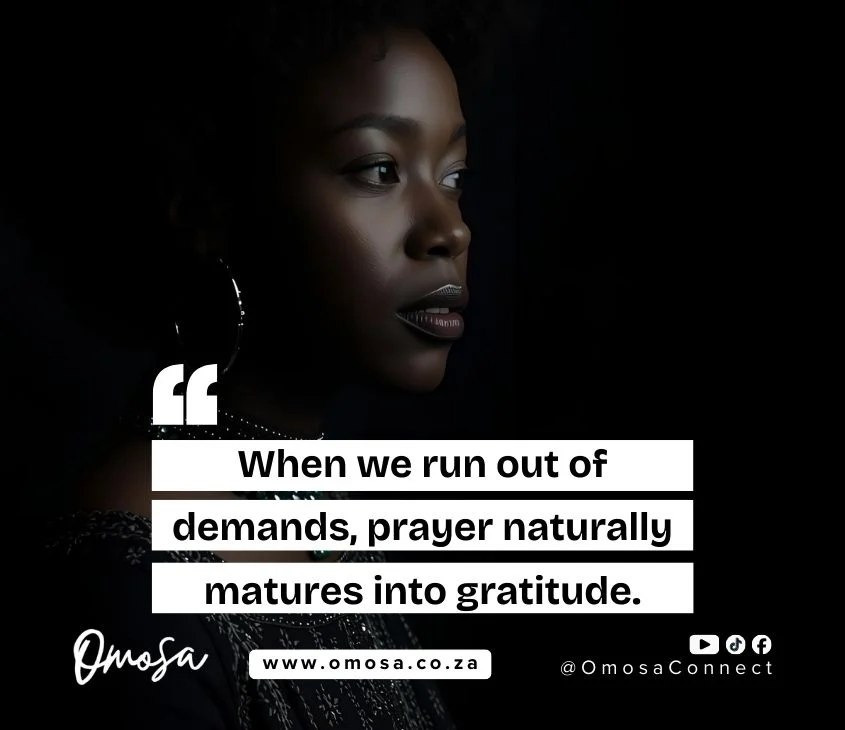
That’s why this line has been sitting with me: When demands run out, prayer becomes gratitude.
Because gratitude is love that notices.
Love that refuses to treat people as scenery.
Love that doesn’t rush past goodness like it’s normal.
Entitlement says: “I deserved this.”
Gratitude says: “I received this.”
That single shift changes the posture of the soul and the quality of relationships.
Psychologically, gratitude interrupts scarcity. It trains your mind away from “what’s missing” and into “what’s real.” Not denial - awareness. Your nervous system softens. Your heart becomes less reactive. Your expectations become cleaner. Your love becomes lighter.
Spiritually, gratitude is worship in plain clothes. It’s the heart returning to truth: God is God, and I am held. I am a steward, not an owner - even of people.
And here’s the Valentine’s twist:
If you want tomorrow to be romantic and holy, don’t start with demands.
Start with gratitude.
Before you ask for effort, honour effort.
Before you request affection, recognise affection.
Before you want more, name what is already there.
Because gratitude redeems the other loves.
It’s Storge redeemed - familiarity that doesn’t become numb.
It’s Philia redeemed - friendship that doesn’t become pride.
It’s Eros redeemed - desire that doesn’t become consumption.
It’s Agape’s atmosphere - love that gives without keeping receipts, because it remembers it has received.
So here’s today’s practice - simple, but not small:
Pick one person. One moment. One mercy.
Then do two things:
- Name it to God.
“Father, thank You for this.”
That’s prayer. - Name it to the person.
“I noticed. I’m grateful.”
That’s love.
And if Valentine’s Day is complicated for you this year - single, healing, grieving, excluded, tired - then let the practice begin with you and God.
Thank Him for breath. For preservation. For the strength that returned after it left. For the quiet ways you’ve been carried. Because love isn’t only roses. Sometimes love is simply still being here.
Tomorrow, enjoy the romance if you have it.
But don’t forget the deeper move: Gratitude first. Because when demands run out, prayer becomes gratitude.
More tomorrow.
One. Perfect. Love
Although it’s beneficial to all, I submit this post mainly with the man and the boy in mind.
Most people talk about legacy like it’s a list of assets: money, property, titles, awards, a business that outlives you, a name carved into something permanent. And those things can matter. They can help. They can open doors.
But they’re not the deepest kind of legacy.
Because what you leave for someone can be taken, spent, lost, fought over, or forgotten. What you leave in someone is harder to erase. It becomes part of how they see themselves, how they treat others, how they lead, how they recover, how they love, how they believe.
Legacy isn’t only an inheritance. It’s an imprint.
The Difference Between “For” and “In”
When you leave something for people, you’re leaving them a resource.
When you leave something in people, you’re leaving them a framework.
- For: a gift, a position, a payout, a connection.
- In: courage, clarity, discipline, conviction, standards, a new way of thinking.
One can assist someone temporarily. The other can transform them permanently.
A person can receive a thousand opportunities and still feel small inside. But one moment of true belief from the right voice at the right time can rewire a life.
Love That Fuels Real Life
Love, in its truest form, is not soft focus. It’s not a slogan. It’s not the kind of kindness that avoids hard conversations.
Real love is a force that makes you more responsible.
Love is what steadies your decision-making when emotions are loud.
Love is what keeps your leadership clean when power is available.
Love is what makes you show up with consistency instead of convenience.
And if we’re honest, the world doesn’t only need more public displays of affection - it needs more people whose love has weight. The kind that builds. The kind that protects. The kind that stays.
Because when love is real, it doesn’t just give… it forms.
Love Month Without the Clichés
February puts love on display, and that can be beautiful. But it can also shrink love into gestures: a post, a plan, a purchase.
Real love is deeper than what you do for someone. Real love is what your presence leaves inside them.
- Do they leave you with more peace or more pressure?
- More courage or more fear?
- More clarity or more confusion?
Because love isn’t only affection. Love is formation.
The Invisible Deposits That Outlive You
If legacy is what you leave in people, then the most powerful legacies are often intangible deposits:
1) Courage
Sometimes your legacy is that someone became brave because you refused to let them live beneath their potential.
You didn’t rescue them. You reminded them. You reminded them that fear is loud - but it doesn’t have to lead.
2) Standards
Love doesn’t just comfort - it builds.
When you model excellence with humility, you leave people with a new standard for what they tolerate, what they accept, and what they believe they are capable of.
That’s a legacy that protects them long after you’re gone.
3) Integrity
Real love has backbone.
It tells the truth. It keeps its word. It does what it said it would do. It chooses what’s right even when what’s easy is available.
And that kind of love leaves people safer, stronger, and more whole.
4) Identity
Some people spend years trying to recover from words spoken over them. Others spend years living from one sentence that healed them:
- “You’re not a mistake.”
- “I see strength in you.”
- “You’re more capable than you think.”
- “You’re going to be okay.”
That is legacy.
Legacy Doesn’t Require a Stage - It Requires Stewardship
You don’t need a platform to build legacy. You don’t need crowds. You need intention.
Legacy is formed through stewardship of what’s in your hands:
- your time
- your voice
- your presence
- your integrity
- your leadership
- your consistency
The truth is: you are leaving something in people even when you don’t mean to. The question is whether it’s life-giving or life-draining.
A Simple Legacy Audit
If your life ended today (or if you simply moved away tomorrow), what would remain inside the people who know you?
Ask yourself:
- Do people feel strengthened after being around me?
- Do they feel safe, seen, and sharpened?
- Do I leave clarity or confusion?
- Do I model surrender… or control?
- Do I plant hope… or anxiety?
- Do I challenge people with love… or just criticise?
Because love that’s real doesn’t just “support” people. It strengthens them.
The Greatest Legacy Is Multiplication
The most meaningful legacy doesn’t end with you. It multiplies.
When you leave something in someone, they carry it into their home, their work, their relationships, and their decisions. Your life quietly reproduces in places you may never see.
That is why legacy is spiritual as much as it is social.
It is not just what your hands built. It is what your life activated.
A Closing Thought
One day, the things we own will belong to someone else. But what we plant into people can echo through generations.
So this month, while love is being celebrated loudly, consider the quieter question:
What is my life leaving inside the people I touch? Because… Legacy is not what you leave for people; it is what you leave in people.
P.S. (A Personal Reflection)
A line from The Bold Reverence, a book I published here on Omosa, reads: “Every decision you make today… is a brick being laid in the foundation of the next generation.”
That’s exactly what I mean by legacy being what you leave in people.
So if love month is going to mean anything beyond gestures, let love become a lifestyle: when pressure mounts, choose the harder right - choose patience, choose integrity, choose love in real time.
Call to action: For the next 7 days, pick one relationship (home, work, friendship) and ask: What am I leaving in this person - strength or strain? peace or pressure? Then make one small “brick-laying” decision daily that leaves them better.
To everyone (but men and boys especially): you may not feel “ready,” but you’re already modelling something. Make it intentional. And to everyone else - join in. Love that lasts is love that builds.
One, Perfect Love.

For the past few years, I’ve noticed something about myself. I’m trying to find the pattern.
Not in an obsessive way, but in an “I’ve seen too many instances of love in my life to call it random” way. I watch my reactions when I’m tired. When I’m hurt. When my love becomes conditional on life being convenient, then I watch God… and I realise my love isn’t like His.
With posts like this one, I feel the intersection with audacity. I mean, who am I to rationalise God’s heart? But then… how dare I not, when I keep seeing traces of His pattern everywhere?
These kinds of topics give me that imposter syndrome feeling - but then again, how dare I not feel unqualified when I am trying to explain anything about God? Can you relate?
On the one side, I feel the kind of humility reminder that says, “Who am I to speak of God?” And then there is another kind that says, “Who am I not to, since I am loved by Him?”
Because if God is the source of love, then love isn’t just something we stumble upon. It has a pattern. It has a design. It has an architecture and infrastructure it flow through. Right?
Maybe it’s because of my hunger to know that I relate to God in different ways - including my intellect. Not the hunger for an inspiring quote about love, but the hunger to know why love heals some and destroys others.
Why love, when taken too far, turns into possession.
Why loyalty becomes tribalism.
Why desire becomes destruction.
Why truth becomes pride.
And why, when God gets involved, love becomes something else entirely.
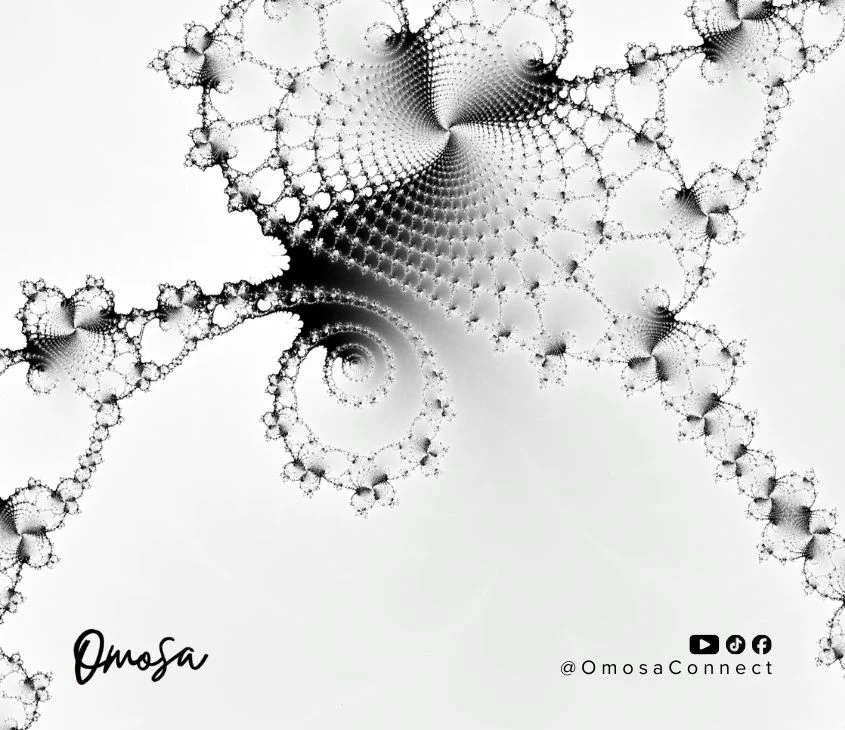
So here is a phrase I’ve been working on lately: The Dynamic Fractal System of God’s heart.
Now, I know what you’re thinking. Fractal? Sounds like something from maths class. And in a way, it is.
A fractal is a pattern or shape that repeats at different scales. You zoom in or out, and the pattern is still there.
Lightning looks like tree roots.
Rivers look like veins.
Lungs look like coral.
Creation likes repetition. Not because it lacks imagination, but because repetition obeys rules.
And when I say Agape is fractal, I mean this:
What is true of God at the cosmic level is intended to be reflected in your life at the individual level. Not as a metaphor. As a call.
God’s heart is not just something we admire from a distance and say, “How wonderful.” God’s heart is something we were made to participate in.
And this is where love stops being sweet and becomes architecture.
Because Agape is not just being nice.
It is self-giving love.
It is truth without fear.
It is sacrifice without resentment.
It does not wait for the timing to be right.
It does not wait for people to be easy.
It does not wait for the conditions to be met.
Agape moves first. That’s why it redefines everything.
Without Agape:
Storge becomes tribal - the familiar becomes a boundary.
Philia becomes elitist - shared truth becomes shared pride.
Eros becomes destructive - desire overtakes responsibility.
With Agape:
Storge becomes hospitality - belonging expands, not contracts.
Philia becomes humility - truth remains teachable, not superior.
Eros becomes covenant - passion becomes promise.
Agape does not supplant the other loves. Agape redeems them.
And this is what we’re going to discover for the rest of this month:
You weren’t simply made to receive Agape.
You were made to become fluent in it.
To carry it.
To embody it.
To live it in such a way that every other love in your life is reordered by it - so that love isn’t just something you feel, but something you do.
F4T – Food For Thought & Reflection
Not the end of the journey. The turning point.
Because once you see Agape as a pattern, you start recognising the counterfeit versions you’ve normalised.
· Love that is really control.
· Love that is really convenient.
· Love that is really fear.
· Love that is really ego, dressed in virtue.
And you start noticing it first… in yourself.
· In how you react when you’re tired.
· In how you handle conflict.
· In how you lead.
· In how you correct.
· In how you forgive.
· In how you speak to yourself when no one is listening.
The audacity is real.
And so is the moment: either keep calling it love… or let God redefine it.
One, Perfect Love.
There is a point in every spiritual journey where things must cease to be matters of information and become matters of invitation.
For a long time, my own understanding of the spiritual journey was that the ultimate objective was to understand love more deeply. Define it more clearly. Explain it more accurately. Gather the right ideas, the right concepts, the right language...And then, somehow along the way, a more subtle truth began to emerge:
Love was never intended to be understood. Love was intended to be moved.
“We love because He first loved us.”
- 1 John 4:19 (NIV)
Those five little words change everything if you sit with them long enough.
Love does not begin with you.
Love does not begin with your capacity for it.
Love does not begin with your personality.
Love does not begin with your relationships.
Love does not begin with your spiritual disciplines.
Love begins outside of you.
And then it flows.
Agape flows out of the heart of God.
Agape flows into you.
And then it flows out into the world.
This is not poetic.
This is not metaphorical.
This is an ontological reality.
A truth about how human beings are designed to work.
You were not created to produce love.
You were created to receive it and transmit it.
To be a channel.
To be a conduit.
To be a system designed for flow.
And this explains something we all know but few of us ever articulate:
When we try to produce love out of our own emotional resources, we exhaust ourselves.
When we try to maintain patience, generosity, forgiveness, or compassion through sheer willpower, it starts to feel burdensome, heavy-laden, forced, and even fake.
Because the system is being used in the wrong way. Love is not something that is self-generated.
Jesus teaches:
“Love one another as I have loved you.”
- John 13:34 (NIV)
We usually interpret this as a call to action. Do better. Be better. Forgive more. But that is not what we're being told. What Jesus is telling us is that the pattern is already established.
As I have loved you.
- First, He received. Then He gave.
- First, He was held. Then He held others.
This is not about changing our behaviour. This is about installing a new operating system on the human experience.
And once you see it, you begin to see the areas where the system breaks down.
When I get impatient, it is because I have stopped receiving. When I get defensive, it is because I have been holding onto an identity that is dependent on external validation. When my love becomes transactional - giving in order to receive, withholding when the other person does not reciprocate - this is what it looks like when the source has been moved inward. It is subtle, but the consequences are huge because channels are not designed to be reservoirs, they are designed for flow.
Personal Reflection
:-) When I would have profound day dreams about my role in The Kingdom, I would often imagine a podcast setup called Audience of One (AO) where I would essentially look into the camera and just speak about the things that crossed my mind that week regarding the work that I am building - writing, teaching, creating space for others to grow and develop and so for. This blog is that in a sense, and what is becoming more and more obvious is the ease with which it is possible to start operating from output rather than overflow.
And sometimes, when fatigue appears on the scene - like it has recently - this fundamental question emerges: Am I giving from effort, or from flow?
To me, the distinction between the two is not about discipline. The distinction between the two is about proximity.
When I am near the source - near the wellspring of stillness, honesty, prayer, and reflection - love becomes less burdensome. Love becomes more expansive. Love becomes less forced.
When I am far from the source - when I am performing - my best efforts feel heavy.
This is not just true for leadership.
This is not just true for writing. This is true for family.
This is true for friends.
This is true for work.
This is true for how I respond to difficult people.
This is true for how quickly my patience wears off when I feel unseen.
The offer of Agape is not to do more.
The offer of Agape is to remain connected.
The power of this system is not within the channel.
The power of this system is within the source.
The Trusth, Architecturally 🙃
Every system within the natural world that supports life is a system of flow. The blood must flow.
The breath must flow.
Energy must be transferred.
Information must be shared. Interfere with that, and the system suffers.
Help it along, and it stabilises.
So it is with this.
When Agape is received, it is then possible to give without fear of running out.
When identity is established as being loved first, love does not have to make any concessions to be safe.
And that is why what Jesus is saying is not a guideline for how to live a better life.
It is a revelation about how human life is, period.
Receive.
Then give.
And stay connected.
Then remain open.
You were not created to admire God’s love from a safe distance.
You were created to participate in it, in willful reverence.
To allow it to flow through your patience. Through your work.
Through your decisions.
Through your responses to situations when no one is looking.
Not well.
Just constantly.
Because the final mystery of Agape is this:
The more it flows through you,
the more it becomes how you live.
Not how you live because you make an effort to.
Not how you live because you perform well.
Just flow.
One. Perfect. Love.
I didn’t post yesterday. Not because the thread broke - but because even daily stewardship must obey the laws of reality: energy, entropy, rest. Creation itself pauses. So do stewards.
Now - back to the centre.
Today I want to talk about the cross, which is often treated as a religious artefact: a symbol of suffering, a theological requirement, a moral transaction. That framing is incomplete.
The cross is not merely something that happened in history. It is a revelation of how reality works when love is allowed to go all the way through.
“But God demonstrates his own love for us in this:
While we were still sinners, Christ died for us.”
- Romans 5:8
Notice what is being demonstrated.
Not forgiveness alone. Not sacrifice alone. But directionality.
In physics, direction matters. In systems theory, flow matters. In biology, life depends on gradients - energy moving from a higher concentration to a lower concentration.
Agape moves downhill. It does not wait for equilibrium. It does not require symmetry.
It flows from fullness into lack. That is not sentiment. That is design.
Agape as the Missing Variable
Storge, Philia, and Eros are real. They are measurable in psychology, observable in anthropology, and modelled in social systems. But they are responses.
- Storge responds to familiarity
- Philia responds to shared meaning
- Eros responds to attraction and desire
But responses alone cannot stabilise a system.
Any system built only on feedback loops eventually collapses into either stagnation or volatility. This is true in:
- Ecosystems
- Markets
- Neural networks
- Relationships
Agape is not a response. It is an initiator. It injects energy into the system without extracting value first. That is why Scripture does not say, “God loved us because…”
It says, “God loved us while…”
While broken.
While resistant.
While unfinished.
This is not moral generosity. It is ontological truth. God does not love because we are good. We become good because God loves.
The Cross as a System Reset
From a technological perspective, the cross functions like a hard reset - not wiping data, but re-establishing the core protocol.
Before the cross:
- Love was transactional
- Worth was negotiated
- Belonging was conditional
At the cross:
- Love precedes worth
- Belonging precedes behaviour
- Identity precedes performance
This mirrors what we now know in psychology:
- Secure attachment produces growth
- Conditional acceptance produces anxiety
- Shame collapses learning systems
Neuroscience confirms it. Theology already knew it.
Agape creates the conditions under which transformation becomes possible.
Repentance is not the door to love. Love is the door to repentance.
Why Agape Is the Pivot
Without Agape:
- Storge becomes insular
Familiarity turns into tribalism. - Philia becomes elitist
Shared truth turns into intellectual pride. - Eros becomes destructive
Desire outruns responsibility.
These are not moral failures. They are predictable system outcomes.
With Agape:
- Storge becomes hospitality
The familiar makes room for the stranger. - Philia becomes humility
Shared truth remains teachable. - Eros becomes covenant
Desire is stabilised by promise.
Agape does not erase the other loves. It completes them.
Just as gravity does not cancel motion - it gives it coherence.
The Cross and Fractals
Here is the part we rarely say out loud:
The cross is not only redemptive - it is fractal.
What is revealed at the macro level of salvation repeats at the micro level of daily life.
- In leadership: power moves downward
- In innovation: value is given before it is monetised
- In biology: life survives by self-giving processes
- In mathematics: stable systems allow loss without collapse
The cross shows us a pattern that scales. A love that does not protect itself at the expense of the whole is the only love strong enough to hold the whole together.
Lived Practice
To live Agape is not to feel more. It is to decide differently.
It is to:
- Initiate repair instead of waiting for an apology
- Create safety before demanding change
- Offer truth without superiority
- Remain open without being naïve
This is not a weakness. It is structural strength.
The cross is where God shows us that the deepest power in existence is the ability to give oneself without losing oneself. That is the love we are invited to steward. Not occasionally. Not emotionally. But structurally, in how we build, relate, design, lead, and remain human. This is Agape.
Not as an idea. But as the architecture of reality itself.
Perhaps the most misunderstood and misused love.
Philautia is the love of self.
And already, for many, alarms go off.
Before Agape can flow through us, something has to be settled within us.
But because we live in a culture that has distorted this word in both directions; on one side, self-love is preached as indulgence, affirmation without accountability, desire without discipline. On the other, it is rejected altogether, treated as selfish, sinful, or spiritually dangerous.
Both miss the point.
Biblically and philosophically, Philautia is not about self-obsession. It is about right relationship with the self.
Jesus points to Philautia when He says:
“Love your neighbour as yourself.”
- Matthew 22:39 (NIV)
That sentence only works if loving yourself is not the problem - loving yourself wrongly is.
You cannot love your neighbour well if you despise yourself. You cannot practice Agape outwardly if your inner world is ruled by shame, self-hatred, or false identity.
There are two forms of Philautia.
Disordered Philautia
This is the love of self detached from truth.
It says, “I am the centre.”
It measures worth by performance, validation, image, or control.
It protects the ego at all costs and resists correction.
This is the Philautia Scripture warns against:
“People will be lovers of themselves… lovers of pleasure rather than lovers of God.”
- 2 Timothy 3:2-4 (NIV)
This form of self-love competes with Agape. It consumes rather than gives. It isolates rather than connects.
Ordered Philautia
This is the love of self rooted in truth.
It says, “I am created, not accidental.”
It receives worth before it performs.
It understands the self as beloved, but not sovereign.
This is the Philautia Jesus models.
He withdraws to rest without guilt.
He names truth without fear.
He gives Himself fully - because He knows who He is.
Ordered Philautia is not self-indulgence.
It is self-stewardship.
It asks different questions:
- Am I living aligned with who God says I am?
- Am I caring for my soul, not just my output?
- Am I honest about my limits - without shame?
This kind of self-love does not inflate the ego. It stabilises the soul. And this matters deeply.
Because people who do not know how to receive love tend to demand it.
People who do not respect themselves struggle to respect others.
People who have not made peace with their own humanity often use spirituality to escape it.
Philautia, rightly understood, becomes the bridge.
Without it:
- Agape turns into burnout
- Sacrifice turns into resentment
- Service turns into performance
With it:
- Love flows freely
- Boundaries become possible
- Giving becomes joyful, not compulsory
Here is the quiet truth most people never hear:
God’s love for you is not opposed to your love for yourself. It is the source of it.
“See what great love the Father has lavished on us, that we should be called children of God.”
- 1 John 3:1 (NIV)
You are not called to erase yourself.
You are called to offer yourself as a living sacrifice.
But offering requires ownership. And ownership requires knowing your worth.
Philautia teaches us how to stand before God without pretending, before others without performing, and before ourselves without contempt.
Only then can Agape move through us without distortion.
So before we continue upward -
before we talk about sacrificial love, unconditional love, divine love, let’s pause here.
To learn how to receive love rightly.
To tend the inner life honestly.
To love the self God created - not the image we curate.
Because Agape does not flow through emptiness. It flows through wholeness.
And this is where that wholeness begins.
One, Perfect Love.
Happy Sunday🫶💗

Agape is sometimes misunderstood as softness, passivity, or tolerance without truth. That is a categorical error.
Biblically, Agape is active, costly, and directional.
"This is how we know what love is: Jesus Christ laid down his life for us."
- 1 John 3:16 (NIV)
💣#1 Agape is not a feeling you fall into.
💣#2 It is a willful orientation of the self toward the good of another, regardless of cost. (💣#3)
Paul defines it with surgical precision:
"Love is patient, love is kind. It does not envy, it does not boast, it is not proud…
It always protects, always trusts, always hopes, always perseveres."
- 1 Corinthians 13:4-7 (NIV)
Notice what’s missing.
No butterflies.
No chemistry.
No mutuality requirement.
💣#4 Agape is not fragile. It does not need to be fed by reciprocity. It is a fire that feeds itself.
Agape versus today's transactional "love languages"
Modern psychology has helped us articulate how people receive love - words, time, gifts, service, touch. This is useful. But love languages answer a different question.
When they ask: "How do I feel loved?" Agape asks: "How do I choose to love?"
Love languages are about preference. Agape is about purpose.
Love languages focus on the self’s experience. Agape focuses on the other’s good -even when it is inconvenient, unseen, or unreturned.
Agape does not ask, "Does this meet my needs?" Agape asks, "Does this reflect God’s heart?"
Personal Reflection
As I continue to write for this platform through posts, blogs, conversations, and the work still to come, something has become quietly but unmistakably clear to me... I don’t need to speak as an expert on love. In fact, the more I reflect, the more I realise how limited my own definitions of love have been. How often I have measured love by how it made me feel. How quickly I have equated love with comfort, agreement, attraction, or reciprocation.
What I am learning - slowly and sometimes uncomfortably - is that love does not originate in me at all. Look, God is not simply better at love than we are.
It's critical that we understand, deeply, that God is not a refined version of human affection. God is the source. Every experience of love we recognise - in family, friendship, work, romance, even longing - is a reflection, however faint, of something that begins in Him.
When I started to see love this way, it influenced a lot of the questions I was asking.
From "Am I being loved the way I want?"
to "Am I loving in a way that reflects God?"
From "Does this relationship serve me?"
to "Does my presence here reveal something of God's heart?"
This shift has been both freeing and confronting. Freeing because love is no longer dependent on my emotional capacity, my energy, or someone else’s response. Confronting because it calls me beyond preference into purpose.
Agape does not wait for ideal conditions. It does not require perfect behaviour.
It does not retreat when love becomes costly. And that has forced me to reconsider where my definitions of love came from in the first place and what my expectations of people should be.
If God is love, not just the giver of love, but love itself, then learning to love is not about mastering techniques or languages. It is about drawing nearer to Him. To know Him.
To trust Him.
To allow His love to reshape the way I show up - at home, at work, in relationships, and in the quiet places where no one is watching.
This journey has convinced me of, at least, one thing: If we want to understand love more deeply, we don’t need better theories.
We need a clearer vision of God. And perhaps that is where real love begins.
In closing, I want to warn you, Idren, that reading what I have written and expecting me to be the absolute reflection of it is a thought that is detrimental to us both.
One, Perfect Love.
I went on a date sometime in 2025 and got the famous “What’s your love language?” question.
I’ve heard it many times before. And usually, I would avoid it or jump straight into answering it - confidently, even playfully. But this time, something felt different. The question landed differently. Heavier. Almost insufficient.
I realised later that it wasn’t the question that had changed. It was me.
Somewhere along the way, my understanding of love had shifted. Not in theory but in substance. What I once thought captured love suddenly felt like it was describing expressions of love, not love itself.
And that realisation stayed with me.
Because love - real, lasting, life-giving love - cannot be reduced to preference alone. It cannot be fully explained by how we receive affection, attention, or affirmation. Those things matter. But they are not the foundation.
Which brings us to today.
Today, we begin to talk about the love that changes the game.
Before we can understand Agape, we must first honour and honestly diagnose the first three loves we’ve covered. Not to diminish them, but to finally see them clearly.
A brief recap of the first three loves and their gaps
Storge is the love of familiarity. It grows quietly through time, shared memory, and proximity. It gives us belonging. It tells us, “You are safe here.” Its strength is loyalty. Its weakness is comfort. Left alone, Storge resists change and can collapse into tribalism - us versus them.
Philia is the love of shared truth and shared pursuit. It is chosen, not inherited. It sharpens, challenges, and refines. It asks, “Do you see what I see?” Its strength is alignment. Its weakness is pride. Left alone, Philia can close ranks, confusing agreement with righteousness.
Eros is the love of desire and attraction. It is the spark that ignites connection and creation. It says, “I want you.” Its strength is intensity. Its weakness is instability. Left alone, Eros consumes itself, mistaking feeling for foundation.
Here is some food for thought served on a critical thinking dish:
All three are responses.
They arise because of something:
- Familiarity
- Shared values
- Attraction
They are real. They are good. They are God-designed. But they are contingent. They depend on conditions remaining favourable.
Which brings us to the fourth word.
Agape: the love that does not depend on conditions
Agape is not the next love in the sequence.
It is the axis around which all the others either mature or collapse.
Scripture does not say God has Agape.
Scripture says God is Agape.
“Whoever does not love does not know God, because God is love.”
— 1 John 4:8 (NIV)
That word for love is Agape. This sets Agape apart. Storge, Philia, and Eros are experiences.
Agape is a posture.
Storge, Philia, and Eros are feelings.
Agape is a decision.
Storge, Philia, and Eros react to goodness they perceive.
Agape originates from goodness itself.
Agape does not say, “I love you because…”
Agape says, “I love you anyway.”
More love tomorrow…
One, Perfect Love.

Continuing with the love bombs…
This is the one we recognise immediately.
This is the love the movies are made of. The songs. The poems. The late-night messages and racing hearts. Romance. Desire. Being “in love.” 🌹
Eros arrives like a spark. Sudden. Electric. Almost undeniable. It makes ordinary moments glow and turns simple presence into longing. Time bends around it. Logic softens. The world narrows to one face, one voice, one possibility.
Eros tells a convincing story.
This will last forever.
This feeling is enough.
This person completes me.
And for a moment, it feels true.
Psychologically, Eros floods the brain with chemicals designed to bond, to focus, to attach. Dopamine sharpens attention. Oxytocin deepens connection. Desire narrows our field of vision so that what matters most feels unmistakably clear.
Philosophically, Eros has always been understood as a force of movement - a longing that pulls us toward beauty, toward union, toward transcendence. Plato saw it as the soul’s desire to ascend, to reach beyond itself toward what it finds beautiful and good.
Because God created Eros.
It is not a mistake. It is not dirty. It is not something to be feared or suppressed.
Eros is the spark of life and creation. It is the ache that draws two people together.
The energy that births intimacy, art, poetry, and even families.
In Scripture, desire is not erased - it is acknowledged, honoured, and placed within wisdom. The Song of Songs does not apologise for passion. It celebrates it.
And yet… here is the hard truth we rarely want to face:
Eros is a hunger. And like every hunger, it demands to be fed.
Psychologically, desire intensifies when indulged without boundaries. It promises satisfaction, but always asks for more. Philosophically, longing without direction becomes restlessness. Theologically, desire detached from purpose becomes disordered love.
Eros burns hot. But it does not burn long on its own. This is where many stories quietly collapse.
When we try to build a life on feeling alone.
When we confuse intensity for depth.
When we expect butterflies to carry weight they were never meant to hold.
Eventually, the chemistry settles. The novelty fades. The spark dims just enough for reality to step back in. And when that happens, Eros panics because Eros cannot sustain itself. It was never designed to.
Eros is the doorway, not the house; the spark, not the firewood. It is the invitation, not the covenant.
Without something stronger beneath it, the foundation begins to crack.
Not because love failed - but because it was asked to do what it cannot.
Still, Eros is not the enemy.
When held with wisdom, it becomes a gift that awakens us.
It reminds us we are alive.
It teaches us vulnerability.
It draws us out of isolation and into risk.
But it needs something deeper to give it shape.
Something steadier to give it endurance.
Something sacrificial to give it meaning.
Eros asks us to want. But love - true love - eventually asks us to give.
Tomorrow, we turn toward that question. The kind of love that does not rise from hunger, but from choice. From will. From self-giving. Can you guess what it is?
One, Perfect Love. 💣