

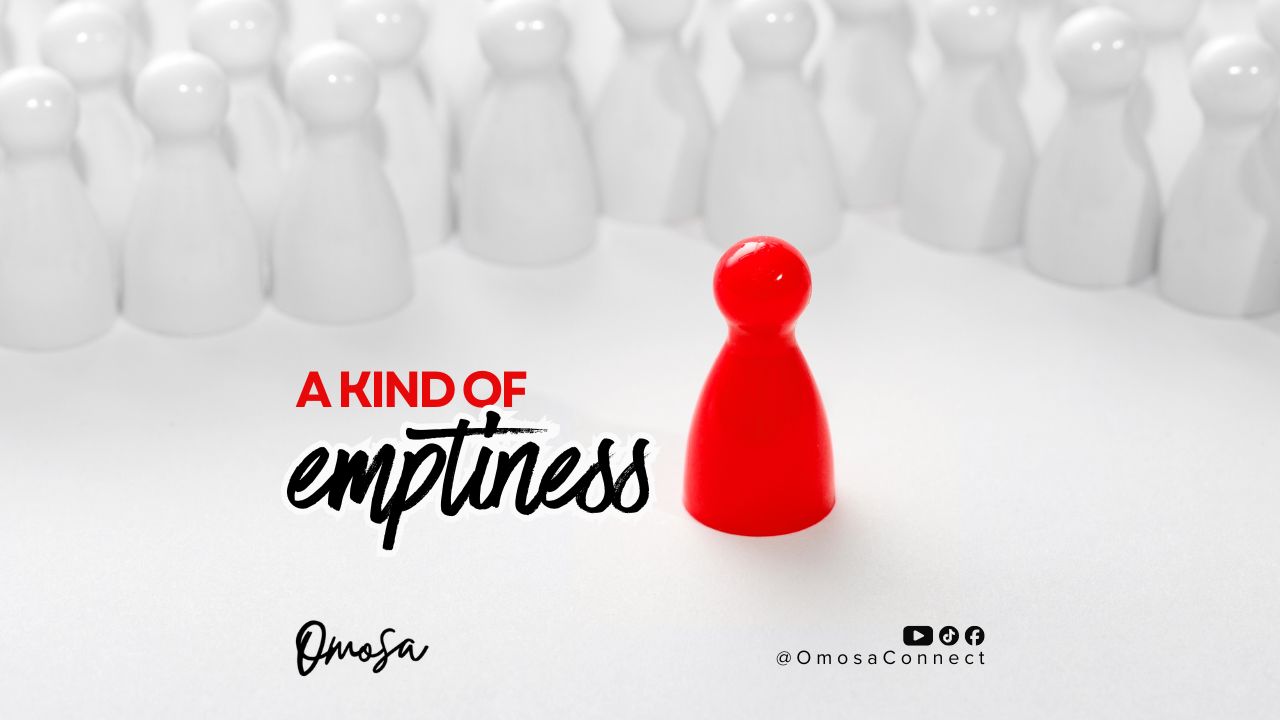

Leadership empties people.
It won’t always happen in a dramatic, collapsing, “I cannot do this anymore” kind of way. Sometimes it is quieter than that. Sometimes you are still showing up, still answering messages, still making decisions, still carrying responsibility, still loving the people, still believing in the work, and still doing what needs to be done. But somewhere inside, something is not flowing the same way.
You are not empty because you have nothing. You feel empty because you have been giving from places that have not had time to be restored, and sometimes, if we are honest, because you have been drawing from the wrong source while still doing the right work. That is a different kind of emptiness. It should make us slower to judge the leader and more willing to ask what has been carrying the one who carries others.
It is the kind of emptiness a parent may feel after holding the whole house together for so long that even tenderness begins to feel like another task. It is the kind that a manager may feel after carrying deadlines, people’s emotions, hidden conflict, pressure from above, and expectations from below, while still needing to walk into every meeting as if they are clear and composed. It is the kind a pastor, mentor, teacher, founder, team leader, elder sibling, community organiser, or strong friend may feel when people keep drawing from their strength, but very few people notice that strength also needs somewhere to rest.
And because leadership often rewards availability, many leaders learn to keep pouring even when the vessel is quietly asking to be still.
The inspiration for this weekly journal came from my thinking about a calabash.
A calabash may be made to carry drink, but in my mind, it is still part of the circle. It should not only be touched when someone is thirsty. It should not only be noticed when it is useful. If it is always being lifted, tilted, and passed around, but never allowed to settle, even what it carries may begin to lose its stillness.
Many leaders know that feeling. They are present, but not settled. Needed, but not nourished. Useful, but not always seen. Responsible, but not always restored. And that is where leadership can become dangerous if the emptiness is ignored.
Because an unrestored leader may still be functional. That is the tricky part. They can still do the work. They can still speak well. They can still make good decisions. They can still encourage others. They can still pay the bills, lead the meeting, prepare the message, send the proposal, discipline the child, advise the friend, hold the family together, and carry the room. But the inner texture begins to change. The people they were called to love begin to feel like pressure. Questions begin to feel like attacks. Weakness in others begins to feel irritating. Small delays begin to feel like disrespect.
The work that once carried meaning begins to feel like a line of demands waiting for another piece of them. And that is not always because the leader has stopped caring. Sometimes it is because the leader has cared for a long time without being restored in the places where care comes from.
This is why leaders must learn to recognise emptiness before they misname it. If you misname it as laziness, you may punish yourself and keep pushing. If you misname it as loss of vision, you may start questioning the whole assignment when what you actually need is restoration. If you misname it as weakness, you may hide it until it becomes hardness. If you misname it as people being ungrateful, you may start bleeding on those who never wounded you. But if you name it truthfully, you can bring it before God before it becomes bitterness.
David said, “He restoreth my soul.” Not just my strength, schedule, productivity or my ability to continue. But “my soul.” That matters because leadership does not only use time and energy. Leadership touches the soul. It touches the place where motives live. It touches the place where love either stays clean or becomes resentful. It touches the place where responsibility either remains stewardship or becomes control. It touches the place where people remain people, or slowly become problems to manage.
A leader can be full of responsibility and empty of wonder. A parent can be so focused on raising a child correctly that they forget to enjoy the child in front of them. A manager can become so alert to what is going wrong that they no longer notice what is growing quietly and beautifully in the team. A founder can become so consumed by survival that even opportunity starts to feel like another threat. A servant in ministry can become so used to giving people words from God that they forget how to sit before God without needing to produce words for anyone else. A strong friend can become so used to being called in crisis that they no longer know how to say, “I also need someone to sit with me.” This is the kind of emptiness we must pay attention to.
Not because leadership should cost nothing. Leadership does cost something. And so do love and responsibility. Building anything that matters will ask for patience, sacrifice, discipline, courage, and endurance. But there is a difference between being poured out in obedience and being emptied by disorder. There is a difference between sacrifice and slow self-erasure. There is a difference between carrying responsibility and becoming a replacement for God in people’s lives. There is a difference between being available and being endlessly accessible. And there’s certainly a difference between leading people and being consumed by them. We need that distinction because some leaders run away too quickly when leadership becomes heavy, while others stay too long in unhealthy patterns and call the damage faithfulness. Neither is wisdom.
The question is not only, “Am I tired?” The better question may be, “What is this tiredness doing to my heart?” Is it making me more prayerful or more resentful, more honest or more performative, more dependent on God or more controlling of people? Is it teaching me humility or hardening me into silent anger? Is it asking me to rest, to ask for help, to set a boundary, to change the way I carry, or to return to the Source before I continue pouring?
This kind of emptiness is not only a sign that leadership is hard. It can also be a signal that the way leadership is being carried needs to be restored. It prompts us to make leadership spiritual before it becomes strategic. Because God does not only care about what the leader produces. He cares about what is happening inside the leader while they produce it. He cares about the father who provides, but has become emotionally absent. He cares about the mother who holds everyone, but has not felt held in years. He cares about the manager whose competence is hiding anxiety. He cares about the pastor whose public strength is covering private dryness. He cares about the founder whose vision is slowly becoming fear in better clothes. He cares about the friend who is always strong because somewhere along the way they learnt that being needed is safer than being known.
God sees the people who drink, but He also sees the calabash; and that is good news. It means the leader is not only valuable when they are pouring. The leader is not only loved when they are useful. The leader is not only faithful when they are exhausted. The leader is not only doing well when everyone else is satisfied. The person carrying responsibility is still a person before God.
Before the title, the role, the need, the emergency, the next request or the next thing that must be fixed; the person carrying responsibility is still a person before God.
So perhaps this is the invitation: do not wait until emptiness becomes bitterness before you return to God. Do not wait until your tenderness has dried up before you admit that something needs to be restored. Do not wait until you start resenting people before you ask whether you have been carrying in a way God did not ask you to carry. Do not wait until your leadership becomes sharp, anxious, controlling, or cold before you allow your soul to be restored.
Let the calabash sit. Let the contents settle. Let the one who pours return to the Source. Let the leader become human again before usefulness becomes a hiding place.
This is not permission to abandon responsibility. It is a call to carry responsibility from a restored place.
Because when leaders return to God honestly, they do not only recover strength. They recover tenderness. They recover wonder. They recover proportion. They recover the ability to see people as people, not merely as needs, threats, interruptions, or demands.
And sometimes that is the quiet miracle leadership needs most. Not a bigger platform, louder applause, more control, or another strategy. But a restored soul.
May every person carrying responsibility recognise the kind of emptiness that needs restoration, not shame. May every home, workplace, ministry, business, friendship, and community learn to see the person who carries, not only what they carry. And may God restore the souls of those who have been pouring from places no one else could see.
Whatever you do today, may it be pleasing to God.
One, Perfect Love.