

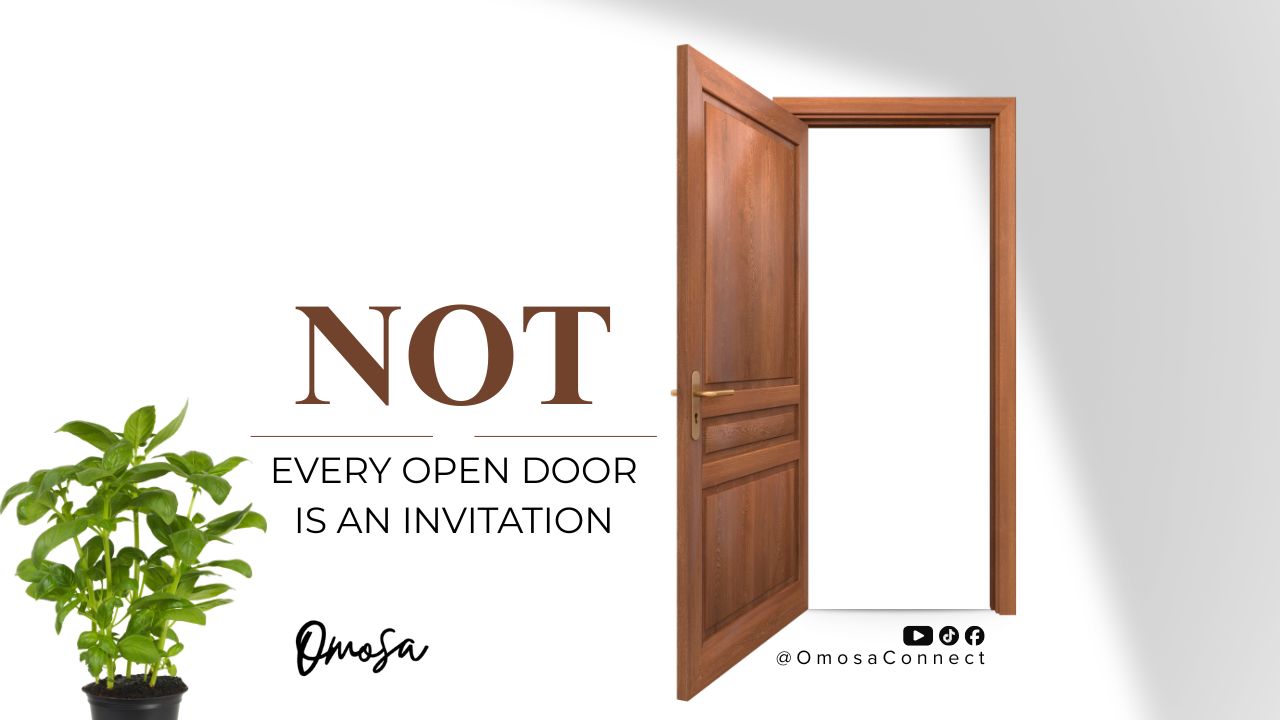

Some doors open because they were meant for you. Some open because they were never locked. And some – the ones that, at times, matter most – open simply to test whether you still remember which ones you were never supposed to walk through.
Is it possible that we have made openness a virtue without stopping to ask what the opening is for? If the answer is yes, it’s possible, then it may very well be acceptable to say that an open door is not the same as an invitation.
A door can open for many reasons. Sometimes it opens because you pushed it. Sometimes because someone else left it ajar. Sometimes because the wind of a season changed direction and, without any effort on your part, a path you never asked for suddenly appeared in front of you. None of these things tell you whether you should walk through.
And yet, for many of us, an open door feels like a summons. We treat opportunity the way a hungry person treats food – as if its mere presence is permission, as if saying no to something available is the same as saying no to something good. So, sometimes, we walk through doors we were never meant to enter, and then we spend years trying to find our way back out.
What I want to focus this post on is the difference between access and alignment
Discernment is not primarily the skill of spotting the open door. It is the deeper discipline of knowing which open doors are yours in the first place. And that is harder, because it requires you to know what you are for – not just what you are able to do.
If left only to its own devices, ability alone becomes a poor compass. The fact that you can do something, that you are good at it, that people ask you to do it, that it would pay well or be admired – none of that proves it is yours. I am not exempt from this, but I have watched gifted people walk through doors that fit their talents and slowly lose themselves on the other side. Not because the door was evil. But because it was never theirs.
An open door is not the same as an invitation. An invitation is personal. It carries your name on it. Access is general; invitation is specific.
There’s a quiet grief you may have to suffer for the right ‘no’
Have you realised that we are not taught to grieve the right no? We are taught to fear it – as if every closed door is a loss and every decline is a retreat. But there is a grief that is holy: the grief of turning away from something that, even though it feels good, is not yours; of leaving a table that everyone says you should sit at, of saying no to the thing that would have made you look successful but you said no so you can remain faithful to the thing you were actually made for.
That grief is not a sign that you chose wrong. It is the cost of choosing well. Every true yes carries within it a thousand smaller noes – doors you will never walk through, versions of your life you will never live. And that is not failure. That is focused alignment.
When we present ourselves before the One, True and Almighty God, the question is not how much can I access? It is what have I been entrusted with? Access flatters the ego. Invitation reveals the calling. One makes you busy; the other makes you faithful. And you can be busy your whole life and still miss the one door that was actually left open for you.
So the next time a door swings wide, do not rush through it. Stand still long enough to ask: Is this open for me – or is it just open? There is a difference, and, for the steward, that difference is everything.
Whatever you do today, may it be pleasing to God.
One, Perfect Love.