

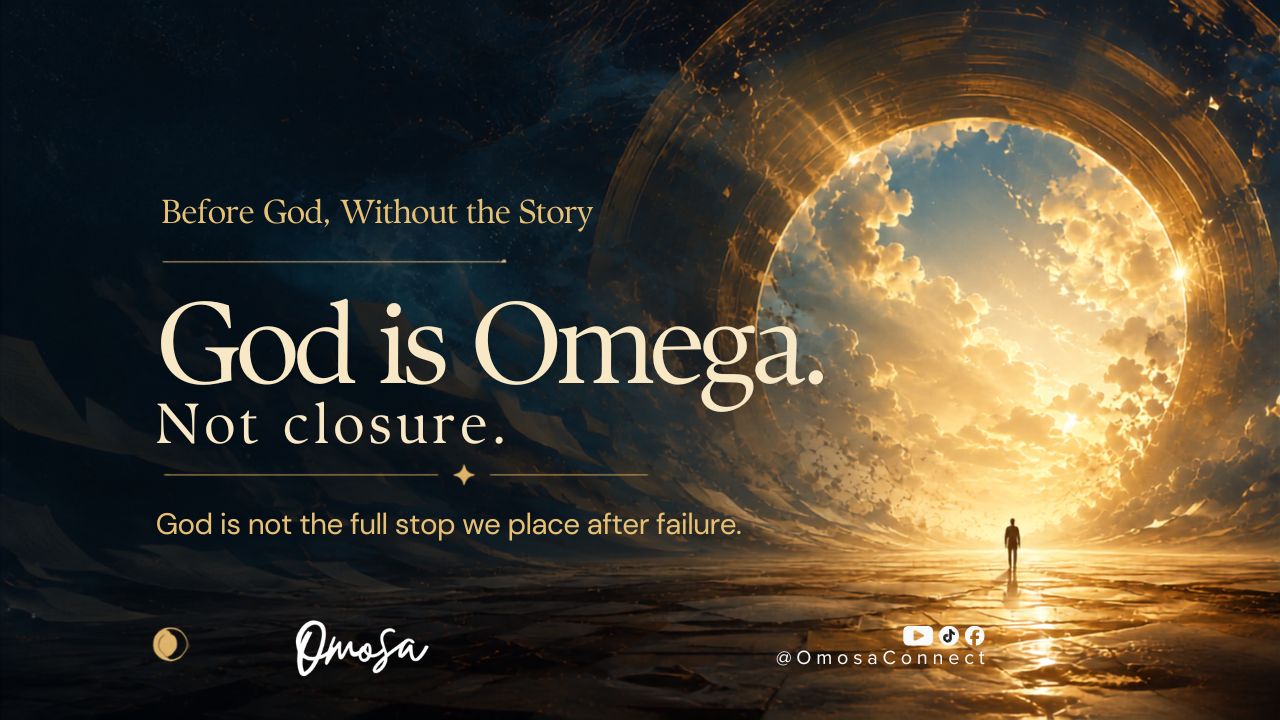

This is the final reflection in the Before God, Without the Story series.
In the first reflection, God Was Not at the Centre, I sat with the danger of using spiritual language too quickly – how a sentence can sound true, but still close a matter before truth has finished speaking. In the second reflection, The Weight of Covenant, I explored the sacred seriousness of what God entrusts to us, and how covenant asks deeper questions than the explanations we give people.
This final reflection brings both thoughts to their rightful place: before God Himself. Because if spiritual language must not become a hiding place, and covenant must not be treated casually, then even our need for closure must be examined before the One who is not merely the end of a story, but the Truth before whom every story must become honest.
God is not a mere punctuation mark we place after failure; He is the ultimate Truth before whom every explanation must yield. God is Omega, not closure.
This is a profound truth. However, it can be a dangerous one if we reduce it to a religious phrase used to end conversations, close chapters, or escape the discomfort of unresolved truth. Omega signifies the end, but not in a superficial sense of closure – not the type of closure we seek when a story still hurts, a wound continues to speak, a memory keeps returning, a decision needs further examination, a failure holds unanswered questions, or when part of us simply wants to conclude, “At least now it’s over.”
God does not embody that kind of closure. He is not the emotional full stop we place after a story we no longer wish to explore. He is Omega – the end in the deepest sense, the final Truth, the fulfilment toward which all things move, the authority before whom every throne becomes temporary, the light that reveals every hidden thing. He is the One who remains when arguments, identities, performances, timelines, explanations, reputations, defences, and our carefully constructed personas have exhausted themselves.
Yet, God is not closure – not in the way we commonly use the term. Closure is not a neat ending, a spiritual full stop, or a phrase that settles a painful matter. It is not the last line we add to avoid the next honest question, nor the explanation we reach for when complexity wears us out. It is not the language we deploy to shield ourselves from accountability, nor the holy name placed over an unfinished inquiry.
I feel the weight of this entire discussion because spiritual language can either mature us or hinder our maturity if misused. We can say things like:
- “God was not in it.”
- “God closed the door.”
- “God removed them.”
- “It was not God’s will.”
- “God allowed it.”
- “It was a lesson.”
- “I have peace about it.”
- “God is in control.”
All of these statements can be true, and at times, they may be profoundly true. They can be the only words that sustain us when life becomes incomprehensible. I am not mocking these phrases; I have needed many of them, used some of them, and may still use them. There are moments when all we can express is, “God knows,” and that is not avoidance – it is surrender.
However, there are also moments when the same words become a refuge. A spiritual answer can serve as emotional closure before the truth has fully spoken. We might say, “God closed the door,” without questioning whether we were careless with the opportunity. We may assert, “God removed them,” without considering whether we mishandled the relationship. We might claim, “It was not God’s will,” without examining whether we ignored wisdom. We can say, “It was a lesson,” without allowing that lesson to transform us. We may state, “I have peace,” when what we truly have is relief from not having to obey. We might profess, “God is in control,” while refusing to yield control over the part of us that still insists on being right.
This is the tension. God is not absent from our explanations, but He must not be simplified to fit them. He is greater than our convenient final word. He is not the closure we use to make a story seem complete; He is the Truth before which our story must be honest. This distinction is crucial.
Closure may put an end to inquiry, while Truth deepens it. Closure may safeguard the speaker, but Truth may liberate them. Closure can be performative, while Truth requires surrender. Closure can be managed; Truth must be obeyed.
This is why I am drawn to the phrase: “Before God, without the story.” The story is not always false; it may contain facts, pain, real betrayal, genuine effort, confusion, history, wounds, injustice, mistakes, consequences, and complexity. However, the story is still not God.
The story may explain what happened but might not reveal the whole truth of who I became in that experience. It may show that I was hurt, yet it may not reveal where I became hard. The story may illustrate my efforts, but it may not show where I relied on my own strength instead of surrendering. It can indicate that I was misunderstood, but it may not display my refusal to understand. The story might point out that I was wronged, without acknowledging where being wronged permitted me to become wrong. It may demonstrate that I survived, yet it may not indicate whether I truly healed. It may show that I left, but it may not reveal whether I left truthfully. The narrative might illustrate that I stayed, but it may not convey whether I stayed faithfully, fearfully, proudly, or resentfully.
This is why God must be more than mere closure. He must be the One before whom the story is examined. Being searched by God is both a daunting mercy and a profound opportunity. It is frightening because there is nowhere to hide, but it is merciful because hiding prevents our healing. Pain can result when God pierces through our performances, but that pain is often the beginning of true healing.
And perhaps that is the healthiest place to close this series. Not with a neat conclusion. Not with a spiritual phrase that makes everything feel settled. Not with the comfort of sounding wiser than we are. But with a quieter and deeper willingness to stand before God truthfully.
- May our language become more honest.
- May our covenants be carried with reverence.
- May our explanations bow before Truth.
- And may we never use God to escape what God is lovingly trying to reveal, heal, correct, restore, and form in us.
That is the journey of this series: not to condemn, not to perform, not to explain everything away, but to return to God without hiding behind the story.
Whatever you do today, may it be pleasing to God.
One, Perfect Love.