
- Optimised the wrong systems: ❌
- Chased the addictive High: ❌
- Confronted the Ego: ✅
- Planted the seed for 'Disciplined Descent': ✅
It turns out, being a Steward is 10% theory and design of the system and 90% realising you’re the bug in your own code.
Oh well, we're here because Modimo o Mosa (God is Gracious)
One, Perfect Love.
The week is ending, and if I’m honest, I’m tired.
It’s not the kind of tired a weekend of sleep can fix. It’s the friction that comes from learning to be a man of character while trying to unlearn automatic, "survival-mode" behaviours that a world of results has baked into us.
Yesterday I shared about the 112 Codex and the architecture of the soul on other days, but Friday is where the theory hits the pavement. For one, it's the day of self-denial, bible study, and it's also the exciting day the spreadsheets close, and the reflective thoughts show their heads.
End of the week thoughts
We are so conditioned to present a finished product... Ne? We want to be 'the guy that has it figured out'... the optimised leader... and maybe more relevant to me...the perfect steward. But this journey and platform isn’t a collection of perfect things; it’s a workshop for the process of becoming. And you cannot inhabit a new version of yourself while you are still desperately defending the old one.
Today, I’m doing a young audit of my own heart. I’m looking at the moments this week where I slipped back into the addiction of the "big break." I’m looking at the conversations where I chose to be right instead of being gracious - ironically violating the very Psalm 112 archetype I claim to pursue.
The truth is, I found some cracks this week. Some were old issues, and some were new fractures from the week's unique demands, like the procrastination of writing a proposal.
But here is the revelation: The cracks aren't the failure. The failure is the lie that they aren't there. We think that by admitting our propensity to fail, we lose our authority. I am learning it’s the opposite. It’s in the honest inventory of our flaws that we actually find the clearance for Grace to do its work and for real growth to occur.
I’m ending my week by letting go of the "super-human" mask. I’m just a man, choosing Modimo over my own ego, and trying to be a better steward of my spirit than I was on Monday.
Before you close your laptop or finish your day: What is one crack in your character you noticed this week? Don't try to fix it yet. Just stop lying to yourself about it. That is exactly where the opportunity lives.
One, Perfect Love.
I am beginning to see that the courage to receive Grace is, at the very least, a radical upgrade to the human spirit.
For most of my adult life, I lived on the razor’s edge of that ever-elusive big break feeling. It’s addictive. It fuels a high. And when untamed, it makes it terrifyingly easy to forget the human at the centre of the pursuit. I became a slave to the fuel - obsessively spending every minute trying and failing to optimise the external systems of commerce, status, and output. I was refining the software of a 'desirable life' while the hardware of my character was suffering from systemic fatigue. I veered not only from my calling but from myself - too busy investing in temporal things to notice I was losing the man God intended me to be, with no mirror in sight.
It is against this backdrop that I am working on a codex: my attempt to map the way back.
This work doesn't spring from my own 'brilliance.' Far from it. It is a retrieval of ancient wisdom from an ancient song. I am codifying the archetype found in Psalm 112: a man whose life isn’t just functional, but foundational. He is gracious and handles his affairs with discretion, yet remains wealthy and steadfast; a man who fears the Lord so deeply that he has no room left to fear the world. I am drafting this not because I have "arrived," but from a place of recovery and self-redesign. I’ve been lost in my previous designs. But I pray that by sharing these new blueprints, someone else can avoid the structural failures I endured before God’s Grace found me.
Let me be bold for whoever needs to hear this:
By choosing Modimo, I am learning that true self-mastery is many things, but it is not an ascent into some super-human state. It is, instead, a disciplined descent into becoming a better human. It is the realisation that the most sophisticated architecture in existence isn't the material-success-pumping-machine we all want to build. Rather, it is the bridge we must steward between the mind and the soul.
The goal, if there must be one, is to become a better steward of the most intricate system ever designed: the indomitable, God-given human spirit.
To every parent, caregiver, and guardian navigating the school runs and the "back-to-reality" chaos across South Africa today: I see you.
Today is the ultimate stress test. Your personal system will be officially under load, routines are hitting the fan, and the transition from the holiday rhythm to the reality of the school term is jarring. It is incredibly easy to lose your peace when the external world is moving this fast, and the traffic is this stagnant.
And let’s be honest - it’s a lot to manage. Some of our kids are buzzing with excitement to see their friends, while others are clinging to us, crying at the gate.
I wanted to quickly share this today:
1. The Stoic Input (Internal Architecture)
Stoicism is a philosophy that teaches us to guard the internal - to focus ruthlessly on only what we can control. This is the "input." You cannot control the taxi that cut you off or the fact that your child forgot their lunchbox. You can only control your response to it.
2. The Ubuntu Output (Human Interface)
However, Ubuntu reminds us that we don’t exist in a vacuum. Our internal state isn't just a personal matter; it is the "output" that affects the child in the backseat, the teacher at the gate, and the frustrated driver in the next lane.
Your "vibe" is actually the most important element of your stewardship today.
- The Stoic keeps you from breaking.
- The Ubuntu keeps you from breaking those around you.
Steward Your Morning
I want to encourage you to remain the "stable system" today. Have the audacity to remain calm when everyone else is honking. Have the humility to realise that your peace is the invisible infrastructure your children are walking on as they head into their new adventures.
Your character is the environment they live in. Sending you love and well wishes today.
One, Perfect Love.
Omosa - We Who Dare to Believe

Often, when we talk about David and Goliath, the first thing most of us remember is the big win. The giant-slaying. The public victory.
Before that spectacle, David spent time in the caves as well. Before he ever wore a crown or sat on a throne, he spent years in the Cave of Adullam, hiding from King Saul and leading a group of 400 men who were "in distress, in debt, and discontented."
I sometimes wonder if he felt like it was a setback (as he was going through it). 🤔But I also imagine that in hindsight, he saw it as a masterclass in what I will call 'Human-Centred Leadership.'
Think about it - David had to be intentional about creating a culture among misfits before he could oversee a kingdom for a nation. He had to learn to manage the friction of 400 broken souls before he could manage the flow of a golden age that followed.
Thoughts on the Design Phase of a Steward’s Journey
In your life, career or your business, you might feel like you are in the "cave" phase. It’s frustrating. It feels small. It feels like the world has forgotten the promises made to you. It feels like regression. It feels embarrassing and belittling.
But I urge you to see this as thethe Design Phase for your transformation. This is the time period where the Audacious Humility of a steward is moulded:
- The Lead-Self Protocol: If you cannot lead yourself in the quiet, you will hardly sustain the noise that comes with the throne.
- The Scale Logic: If you cannot steward a small team of three with excellence, you will crush a team of three hundred with your ego and ownership mindset.
- The Throne as an Amplifier: The throne doesn't create character; it simply reveals it. When the architecture of your character is cracked in the cave, the weight of the crown will shatter it.
So use the design phase to work on the most critical parts of your character when no one is watching.
Mastery in the Dark
The cave is where self-mastery happens. It’s where you learn that The Work is the Worship, even when there is no audience. Don't despise the smallness of your current project, assignment, phase or the obscurity of your current season.
You are building. You are in a season where you can cultivate the habits and begin thinking about the exact culture that will eventually support your kingdom.
One, Perfect Love.
I’d like to connect with you. Tell me:
- What are you working on in the cave today?
- What is one 'inconvenient' lesson the cave is teaching you right now that you know you'll need when you finally reach the throne?
Omosa - We Who Dare to Believe
We have a habit of compartmentalising our lives. We offer God our spirit on Sundays, but we give the world our skill on Mondays - as if the two have nothing to say to each other.
As a product of Audacious Humility, I look at systems. The most broken system I see today is the one where believers think their "ministry" only happens when they are holding a Bible.
It doesn’t.
Scripture gives us a clear design specification:
“Whatever you do, work at it with all your heart, as working for the Lord, not for human masters” (Colossians 3:23).
This isn't just a nice sentiment or a suggestion; it’s an architectural requirement for a life of integrity. In a human-centred system, it means:
- The spreadsheet isn't just data - it’s an act of stewardship.
- The email to the frustrated client isn’t just "customer service" - it’s an exercise in patience and integrity.
- The investment or sweat equity isn't just a legal filing - it's where servanthood meets the boardroom.
The Work is the Worship.
If we are "God-fearing" on Sunday but "tyrants" in the office, our system has a critical failure. If our faith doesn't change the way we treat the person who can do nothing for us, then it’s just a hobby and a label, not a conviction.
We don't need more people "talking" about faith in the boardroom. We need people whose work is so excellent, whose character is so stable under pressure, and whose empathy is so consistent that the world is forced to ask where that architecture comes from.
Your desk is your altar. Your craft, talents, and skills are your offering.
Stop waiting for a "sacred" moment and start stewarding the one you are in.
One, Perfect Love.
Is it possible that you are not tired because of the work you do, but because of the weight you carry?
We often confuse the two.
Work is the exertion of energy. It is the calories you burn, the calls you make, the strategy you build. Work is holy. We were designed to work.
Weight is the emotional burden of the outcome. It is the belief that if you stop working, the universe will collapse. Weight is toxic. You were not designed to carry the world; you were designed to live in it.
The fatigue you feel at 3 PM is real; the work is indeed demanding. However, often what turns healthy tiredness into draining exhaustion isn't just the complexity of the task, but the silent, internal pressure of the 'Self-Made' Operating System.
This self-made system whispers a lie to you every morning: "I am the Source. I am the Sustainer. I am the Protector."
This is the Anxiety of Ownership. When you believe you own your life, you live in a permanent defensive crouch. Your hands are clenched tight, terrified to lose what you have built. You cannot receive, and you cannot rest. The Owner never sleeps, because the Owner thinks he is God.
IT IS TIME TO LET GO OF THE SELF-MADE MINDSET.
We, who dare to believe, propose a radical structural renovation: Resign as the Owner. Be re-hired as the Steward.
A Steward does not own the asset; they manage the Trust.
- The Owner stays up all night worrying about the foundation cracking.
- The Steward calls the Architect.
When you make this shift, the work remains high-performance, but the weight vanishes. You move from the fragility of the "Self-Made" to the authority of the "Grace-Made."
When you make this shift, you move from the fragility of the "Self-Made" to the resilience of the "Grace-Made."
If you are ready to trade the anxiety of ownership for the authority of stewardship, your apprenticeship begins here.
"The world seeks to legislate goodness through fear and consequence. A steward cultivates goodness through vision and discipline. While this is easier said than done, we should strive to design a life that doesn't require policing."
Easier Said than Done
Some of us operate our lives like a holding cell. We behave only because there are walls, guards, and the threat of punishment. We do not steal because we fear jail. We do not cheat because we fear divorce. We do not slack because we fear poverty.
This is the method of Legislation. It works from the outside in. It assumes that at your core, you are chaotic and untrustworthy, and therefore, you require a cage of rules to keep you in line.
Compliance is not character. If we are only honest because we are watched, we are not people of integrity; we are simply people with good risk management.
We cannot live like this anymore.
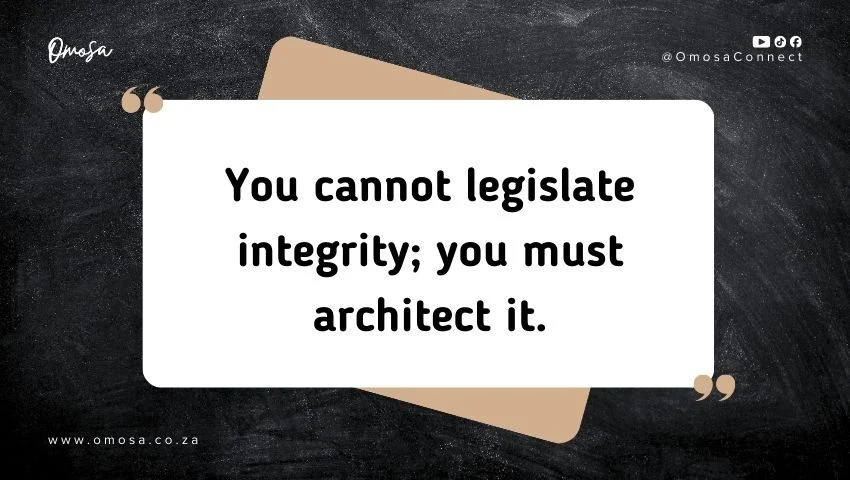
A steward is the person who understands that true power is not found in avoiding the consequences of the law, but in constructing a life that rises above it. We must move from Legislation to Architecture.
Structural Integrity
Good architects do not rely on a sign that says "Do Not Fall" to keep a building upright. They rely on physics, materials, and design. The building stands because it possesses the internal structural integrity to handle the weight.
Our lives require the same engineering.
To architect goodness requires Vision. You must see a version of yourself that is higher than the standard set by the world. You must see a version of yourself that forgives you for your past mistakes, takes accountability for them, and never repeats them. We live in a world that asks, "Is it legal?" But stewards should ask, "Is it honourable?"
The Audacity of the steward is the refusal to lower his internal standard to match the low expectations of society. It's easier said than done. But it's worth it.
To architect goodness requires Discipline. Vision without discipline is merely a dream. Discipline is the steel beam. It is the Humility to submit to a greater good - to choose the hard right over the easy wrong - even when there is no audience to applaud you and no policeman to arrest you.
The Hard Work of Design
Let me say it for the 4th time: This is easier said than done.
It is exhausting to be your own standard-bearer. It is easier to drift. It is easier to let "a lesser fear" be your motivator. To build a life of internal structure requires you to confront your own shadow-self - your ego, your appetites, and your laziness.
This is why we use the Audacious Humility Codex (AHC). It is not a magic trick; it is a construction method.
- Anchor: We look in the mirror to find the cracks in situations as they arise.
- Refine: We recalibrate ourselves to ensure that our next move aligns with the ultimate blueprint of where we are going in the long term.
- Cultivate: We respond appropriately to ensure that our actions are character-defining and legacy-building.
The Verdict
We are not here to raise a generation of people who simply follow the rules. We are raising a generation of Upright Stewards who do not need the rules because their internal standard is already higher.
Do not wait for the world to tell you who to be. Do not wait for the consequences to force you into line.
We must, and I mean MUST, architect our integrity.
One, Perfect Love.
We are often told that "fear is a liar." We are told to be "fearless." But this is not entirely true. Good fear, in its purest form, is not an enemy; it is a tool. It tells you what you value, what you respect, and who you (should) answer to.
The problem with the modern believer is not that we have too much fear. It is that a lesser fear consumes us because we have lost sight of the Greater Fear.
When we follow the Psalm 112 Archetype, we read: "Blessed is the man who fears the Lord." (For those new to the Audacious Humility Codex, the Psalm 112 Archetype is our blueprint for the 'Blessed' - a person whose life is structurally sound because it is built on the bedrock of reverence rather than the shifting sands of self.)
This is the Greater Fear that I am referring to. It is not the terror of a victim cowering before a tyrant. It is Reverence. It is the breathtaking awe of standing at the edge of a roaring ocean or gazing into a galaxy. It is the realisation that God is big, His standard is holy, and His word is the only one that matters.
When you are filled with this Greater Fear, it acts as an anchor. It makes you heavy with purpose and steady in the storm.
The Trap of the Lesser Fear
But when we lose our awe of the Creator, we immediately begin to bow to smaller gods. We become enslaved by Lesser Fears.
A lesser fear is any fear that is rooted in self-preservation rather than God-glorification. It is the noise that whispers:
- "What if I run out of money?" (The Fear of Scarcity)
- "What if they reject me?" (The Fear of Man)
- "What if I get caught?" (The Fear of Consequence)
These fears are "lesser" not because they don't feel real - they feel very real - but because they make you small.
The Exchange
Consider the man who refuses to cheat on his taxes.
- If he refuses because he is afraid of an audit, he is driven by a Lesser Fear (The Fear of Being Caught). He is acting like a prisoner.
- If he refuses because he knows that dishonesty insults the God who provides for him, he is driven by the Greater Fear (The Fear of the Lord). He is acting like a Steward.
The outcome (honesty) looks the same on the outside, but the internal architecture is completely different. One man is Self-made trying to protect his pile; the other is a Steward honouring his assignment. Both can be high-stress occupations but the stewardship mindset cultivates more peace because you are simply managing the flow.
Here is the spiritual physics of stewardship: You cannot simply "stop" being afraid. You can only displace one fear with another.
- If you fear the opinion of your boss more than the opinion of God, you will compromise your integrity to please him.
- If you fear the lack of money more than you trust the Provider, you will hoard instead of scatter.
But the moment the Fear of the Lord becomes the weightiest thing in your life, the lesser fears evaporate. You stop worrying about what people think because you are too busy wondering what God thinks. You stop worrying about running out because you are in awe of the Source.
To audit yourself, look at these symptoms:
- The Fear of Man reveals a lack of awe for God’s Approval.
- The Fear of Scarcity reveals a lack of awe for God’s Provision.
- The Fear of Failure reveals a lack of awe for God’s Sovereignty
Elevate Your Reverence
For We Who Dare to Believe, to build a life of Audacious Humility, we must audit our fears.
When anxiety grips your chest, ask yourself: "What am I bowing to right now?" Is it the fear of failure? The fear of poverty? The fear of irrelevance?
Do not just acknowledge these fears - displace them. Take a moment to practice The Pivot: Identify the lesser fear, then immediately name the attribute of God that makes that fear look small.
These lesser fears are unworthy masters.
We must use the Anchor of our AHC to return to the only fear that heals: The Fear of the Lord.
- A lesser fear makes you hide.
- The Greater Fear makes you stand.
- A lesser fear builds a cage.
- The Greater Fear builds an Ark.
Do not be fearless. Be God-fearing. And when you elevate your reverence, you will find that you have nothing else left to fear.
One, Perfect Love.
As 2025 draws to a close and we approach 2026, I wanted to share with you all an abridged personal reflection on this past year.
I have been quiet - well, maybe just silent - not because the mission stopped, but because I was being remade. For many months, I entered a period of deep introspection and fought silent internal battles that I now recognise as my own wilderness. It was a time of stripping away.
At first, I wasn’t sure what was being stripped away because, in my mind, the Audacious Humility Codex (AHC) framework was already "it." But there was an internal gnawing that kept pulling me back toward myself every time I wanted to "push" Omosa. I had to fight the battle of brand identity - I had to answer tough questions like: "Are you a religious movement or a secular movement that exploits faith?" Grappling with those questions took time. But eventually, there was clarity. Stewardship is a mindset and a spiritual posture.
The Burden of Ownership
Many of us carry an identity without realising it - the heavy, anxious burden of believing we are the masters of our outcomes and the owners of our lives. This is the "Owner Mindset." During my silence, I received a clear epiphany; a revelation that I believe is the foundational operating system for the generation we should be championing: Stewardship.
The Audacious Humility Codex (AHC) finally found its true anchor. I realised that the Audacity to build and the Humility to remain grounded only work when they are fueled by the understanding that we own nothing. We are simply stewards - of our individual assignments, our intelligences, our gifts, our resources, and our lives.
I didn’t find this in a book; I found it in the stripping away of the silence.
A New Resoluteness
As we stand at the dawning of a new calendar year, I am no longer interested in the "hustle" or the "grind" of ownership. My focus has shifted to the resoluteness of the mission. The new year should find us in a season that is no longer about resolutions; 2026 will be a year of stewardship - and every year after it. We will move through the 7 Domains of life not as people trying to accumulate, but as stewards committed to excellence and multiplication.
My wish for you in these final days of 2025 is simple: May you find the courage to lay down the burden of trying to own your life, and may you step into the authority of stewarding your purpose.
Rest well. Reflect deeply.
One. Love.
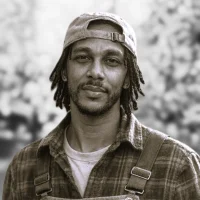
Tsholo L. Sehume
Omosa Founding Steward.