

Have you seen that viral video? You should. You know those phrases that roll off the tongue and sound like a complete mishmash of words, kind of like the spiritual riddle, “born once, die twice; born twice, die once”? There is a video of two men in public, having a friendly exchange, who present a similar riddle. The video went viral, and I want you to take a quick look at the video first...
Did you hear that? He said, “You cannot believe something and know it,” and “You can only believe in what you don’t know.”
The man continues, citing Jesus as the example that caught my attention this time around: “You might believe in Jesus… ’cause you don’t know Jesus.” He finishes with this thought: “Therefore, understand that belief is a form of doubt.”
This catchy phrase that he uses hit me different. So I had to pause and think. “You cannot believe in something and know it.” Hmm! This implies that this faith of ours is inextricably tied to scepticism. Does this mean that if my faith is real, that if I truly know God, then I must not believe but know? I had to pause. As someone who is learning as they grow and growing as I learn, I have to reject this notion that faith is based on doubt.
Okay, I follow the logic in what the man is saying – to me it makes sense in some contexts – that intellectual evidence basically cancels out the need for mere belief. Yes, but in domains such as spirituality, I believe that knowledge and faith are not opposites. Instead, they are a non-negotiable duo, a super combo that is, in fact, the very foundation of The AHC system and The Bold Reverence prayer sessions. They are a combo where faith (belief) is humble enough to surrender and submit to God, while knowledge is audacious, bold, and uncompromising in the certainty of action when in pursuit of the highest good (love your neighbour as yourself).
I have some thoughts I want us to explore in this insert:
1. The Posture of Grace: The Humility of Belief
Even before I chose to get on this path to pursue the love of God, the world (as I used to think, too) has always been persistent in insisting that faith or belief are nothing more than ignorance and the absence of knowledge. I want to accept that as a challenge and redefine it for our purposes. I, while on this journey of growth, choose to define belief as a Bold and Audacious Choice – the Source of Our Humility, Surrender, and Obedience.
Bold statement number 1. Here, at Omosa, our faith is not a ‘doubt’; it is a conscious act of will that sets us free from the need to control the universe. It is our conscious decision to put our faith in the infinite and invisible aspects of God’s plan, beyond our finite comprehension. We believe in things we have not yet touched with our hands or scientifically explained because, for us, that is the path to grace and the miraculous, wonderful, and unexplained. For us, Hebrews 11:1 tells exactly what belief is all about. It says, “Now faith is the substance of things hoped for, the evidence of things not seen.” (KJV).
For us, here, to stand in Reverence is, essentially, to say: “I am finite. I choose to believe in the Infinite.” This decision keeps us grounded in grace (mosa), reminding us that God surpasses our understanding and intellect. This is our bold act of humbling ourselves to receive the strength that God gives us to empower us to walk in faith.
2. The Posture of Certainty: The Power of Knowing
Although faith is the starting point of our experience, knowledge becomes the connected and necessary end. Here, we take a stance that is not afraid to consider that we can have conviction about things beyond the physical realm. In our world, we stand against the idea that the material sphere is the be-all and end-all of knowing.
Bold statement number 2: Our knowledge of God is not academic. We have certainty, from personal experience and due to a real relationship that God exists. In the video, the man presented a linear, concrete form of proof: “How do you know that you are a white man? Explain to me how you know this?” The man replied by sharing lineage information – this is a physical form of knowledge.
But our knowledge of God is not linear. We don’t know God the way we know that 2+2=4. We know God the way a child knows a parent – through intimate, frequent, personal interaction, daily provision, and agape love. This is the close knowledge that is the Hebrew Yada, knowledge by personal, deeper experience.
Jesus pointed to this relational truth in John 17:3: “And this is eternal life, that they may know You, the only true God, and Jesus Christ whom You have sent.” This knowledge is eternal life, moving beyond abstract thought knowledge into a deep, relational experience.
It requires exceptional boldness to state, “I’ve tasted and I’ve seen. I know the Infinite. I KNOW God.” It is that level of faith that puts a fire in your belly, brings tears of joy to your eyes, and loads up courage in your heart.
3. “Until you go and taste them”
The man in the video uses the powerful analogy of water in various colored cans: blue, yellow, white, and black. An external observer, by mere sight (intellect/shallow observation), shall assume the content to be different. To know for real what is in it, you need to taste it – you need to experience the water (the Spirit).
This is where your conviction becomes undeniable. Your experiential knowledge – that peace in crisis, that answered prayer, that undeniable calling – is your spiritual “taste test.” It is the proof that transcends the debate of mere human logic.
In the video, the man says something like: You won’t know what’s inside the cans until you go and taste them. So, let’s use that imagery:
- Our belief is like our container that carries the water (Belief for us, in this analogy, takes the form of the humility that brings the cup to God, asking for it to be filled or refilled or used to fill another’s).
- Our knowledge is our undeniable certainty (Knowledge, for us, comprises the audacity we then gain once we’ve taken that first sip that gives us the unquestionable certainty that indeed, God is alive, exists and is all-knowing. For us, our knowledge is based on the fact that we can’t know everything, but we now know the one who does!)
Bringing it all together…
When belief and knowledge intersect, we discover, rather than contradiction, a beautiful combination: The Bold Reverence – the Audacious Humility. The Born Once, Die Twice; Born Twice, Die Once…
It is here where we begin to answer the question, “So, which is it: do you believe or do you know?” It is here where humility meets conviction; where meekness meets certainty; where surrender meets confidence. Here, the combined encounters remind us that no decision is required in selecting one or the other. They are a necessary, awe-inspiring pair in our journey to living a full life.
In closing
We, who seek wisdom like Solomon, know that to remain humble and in awe of God’s vastness is Reverence. We know that to remain steadfast and firm in the unshakeable faithfulness of God is Boldness.
So, the next time you’re given the question, you can answer with truth and strength, no apology, no arrogance. Say it loud and proud:
“I have come to know that the God I believe in is real. I believe in God in such an intimate way that it’s an undeniable truth.”
To: the friend I have not yet met,
From: Me, Tsholo L. Sehume
Dear Friend,
Have you ever felt haunted by the feeling that something vital is lacking, especially in matters of love?
What a greeting to a letter, huh! 🙂
Look, I don’t know what your name is, and I don’t know your story. What I feel I do know is a tiny bit of every man’s your heart – a bit that I suspect may have, at times, beat with the same restless question that echoed in mine over the years. It’s this feeling of something missing that’s similar to attempting a tough recipe; you follow what it says, but this persistent suspicion lingers that a vital ingredient has been left out. The dish tastes good, perhaps even excellent, but it’s incomplete. Something is missing…
Perhaps this has not been your experience, but it definitely has been mine. I find myself wanting to write that in the past tense – “it had been” – but this is a realisation I struggle with to this day. Growth, as they say, is not a destination but an ongoing unfolding. Anyway…
Getting back to this sense of something missing… For a time, I felt I had a good grip on love. I allowed myself to receive and I also invested in giving, caring for, and taking great care not to get in the way of another’s peace, often going the extra mile. But these are the fundamentals in love. Right? No gold star there.
I even did some reading on “love languages” so that I would be familiar with what’s on offer since it was the talk of the town. I worked hard to be well-versed, wanting to fill the “love tanks” of those in my life while keeping a watchful eye on the levels of my own.
I am not going to lie, that model was unquestionably useful; it gave me a language for the hard talks of how I receive and give love. But if I am being totally truthful with you, from the very first moment I came across it and even after utilising it, it ultimately made me feel less like a lover and more like a bookkeeper. Something deep-seated in me began to reject it, by and large. I became uncomfortably aware that, despite my best intentions, there was a scoreboard being used to record my efforts as much as I was keeping a subconscious scoreboard – a record of debits and credits, of services performed and affirmations due. It was a closed system, and it was exhausting. It is exhausting. For me, the love languages approach feels like operating from a place of scarcity where two half-empty cups are desperately trying to fill each other – a noble, yet ultimately impossible, endeavour.
At the back of my head would reside this silent question: “Is this all there is?”
It is a question that can be consuming, haunting you like a shadow for years. The emotion that comes with the question is even worse because it has the potential to push us toward drastic and compulsive choices; anything to get rid of the profound discontent that sits inside of us, waiting to turn into resentment – for our situations, our surroundings, and even the people we love.
I have been fortunate – very fortunate – that even when I was unhappy profoundly and hurt, I never made the transition to resentment. But man, the persistent feeling that ‘something is missing’ ate away at me gradually. Because, inexorably, the thought turns inward: perhaps I am the one who is missing the point. It’s the subtle humiliation of, “Why don’t I get it?” Not a very comfortable feeling at all.
And then, something changed.
It was not a lightning flash or a great revelation. It was a gentle, quiet impression that came into my heart while in prayer. A thought so simple it was almost obvious. Can you relate?
You know… that moment when clarity comes, and you realise the truth has been in front of you the whole time, just waiting to be noticed? And when you ultimately notice it, you suddenly have the words to describe the very state of your soul… That is precisely what happened with me.
The trigger was a conversation in which I was asked, for the umpteenth time, “What is your love language?” This time I stopped. As I hesitated, the person pushed, “Tsholo, it’s not that difficult. Why do you want to make easy things complicated? What is your love language? Is it acts of service? Quality time? What is it?”
Luckily, the questioner was a fellow recipient of grace from whom I learn about loving and knowing God, so I requested a moment to think. When I finally answered, typical of me, it was with yet more questions: “What is love? What is language? I need to really think about this.” Something deep had been stirred. In the midst of my life’s complexities, I shelved the thinking for another time. Unbeknownst to me, a seed had been sown on fertile soil.
Not long afterwards, one morning, as I brushed my teeth and reflected, the term “Intercession” fell into my spirit.
I kid you not, that word made me want to go out and defend myself to all the people I ever felt had not understood my love language. I was so thrilled to have finally discovered a key to something that had plagued me all my life, because sometimes our way of loving is not understood. In my own life, it was not only other people; I finally had words to express one of the essential ways I show love to myself.
Alright, so I’m there, having my ‘eureka’ moment, prepared to go back to my friend with the promised answer, when a new question came to mind: where does “intercession” fall into the given ‘love languages’ system?
It wasn’t straightforward to me. Then another question came: Is intercession even a language? Then another: Is love a language at all?
Ah! The spiralling began. It continued until I decided to sit with these questions, to inquire into my thoughts and feelings. All of this culminated in a simple perspective-shifting realisation:
What if love is not a language we learn to have our needs fulfilled, but an attitude we take to give from a place of abundance?
It was no surprise, therefore, that this understanding eventually led me back to God. “…, God is love,” after all (1 John 4:8). This one idea changed everything. I changed how to proceed with answering that question I had at the beginning of this letter: “What if you have been haunted by the feeling that something vital is missing, especially in matters of love?”. I felt like I finally had the GPS coordinates to the answer.
There is validity to the statement that love is a universal language. Reducing it to five categories – basically interested in one’s preferences and one’s tank, with a sympathetic consideration for the preferences of others – is incredibly restrictive and not universal at all.
In came the word “Posture”.
A posture, on the other hand, is about my orientation toward the next person. A posture indicates a readiness to move, to change, to serve. It shifts the entire focus away from the self and toward the other.
In the Bible, “posture” refers both to the physical body positions during worship and to the spiritual attitude of the heart, with the latter being the primary focus. Physical postures like standing, kneeling, prostration, and sitting all convey a heart attitude of humility, submission, respect, or devotion to God. The Bible encourages a posture of the heart that is humble, obedient, and aligned with God’s will, and it also uses metaphorical language about walking, standing, and sitting to describe different spiritual ways of life.
A friendly warning, however:
- This concept of posture must be based on abundance – God’s love -Agape -for it to be long-lasting, sustainable, enough, filling, rewarding;
- It’s more easily said than done; and
- It does not nullify the use of love languages and other tools and instruments to better position yourself to love others.
Then, after all, my friend, I reached something that I would like to present to you:
This solves the empty cup challenge. We cannot fill each other; that is true. But what if we were never supposed to? What if we were designed to stand alongside a river -an endless, universal, bottomless source of God’s divine love -and simply let the overflow pour through us into the lives of others?
Friend, I am writing to you because this idea is burning a fire in me, and I have to hope I am not the only one who has looked for it. I don’t have it all figured out. Not by a long shot. But as I’ve started to look into these postures, they feel more true and freeing than anything I’ve known. I am writing to you to say give it a try and see what your experience is.
What if
- Love assumes The Posture of Covenantal Presence?
- A kind of love that simply stays.
- A love that dares to sit in the darkness of a friend’s suffering without trying to repair it, bringing the deep solace of just being present.
What if
- Love is like The Posture of Intercession & Advocacy?
- A love that battles for a person on its knees.
- The silent strength that guards an individual’s name when they are not around.
And what if
- Love takes on The Posture of Edification & Truth?
- A love bold enough not just to affirm, but also to confront.
- The “iron sharpens iron” love that sees the gold in someone and lovingly calls it out, even when it’s uncomfortable.
These are just sketches and outlines of a new kind of being that I’m learning, and working on. It feels like homecoming. It’s a love that doesn’t keep score. A love that isn’t rooted in my performance or your perfection. A love that is, at its core, a response to God’s grace (Mosa wa Modimo).
For indeed Modimo O mosa – God is gracious. God is love. God’s love is the source, the river. With this new way of approaching love, Agape love, all I am asking you to do is to merely learning how to stand in it, taking on postures that enable us to become conduits for God’s love and will to be accomplished in and through our relationships.
I’m sharing this part of my journey with you, dear stranger, with the hope that it will serve to bring some light or liberation. I don’t know if you’ve ever sensed that same gentle yearning for a love that’s larger, deeper, and truer. A love that welcomes peace that surpasses all understanding, God, into each exchange, praying:
“Dear God, I am always imperfect, but I rely on Your grace for sufficiency. Your Word tells us that faith without works is dead (James 2:26), so Lord, in this situation where I am called to love, how can I be a channel so that Your love pours through me, accomplishing Your will?”
Agape love doesn’t come with a new set of rules. This is an invitation to a renewing of our minds and a transformation of our perspective as we serve lovingly.
Your stranger friend on the journey,
Tsholo L. Sehume

We live with a strange and beautiful paradox.
On the one hand, you are exactly who and what you are—the sum total of all the moments, all the decisions, all the ups, all the downs, and all the experiences that have led you to this exact moment in time. In that sense, you could not possibly be anyone else.
But, on the other hand, can you attain perfection? Definitely not. None of us can. We carry our blemishes, our pain, our achievements, we fall, and we bear our scars.
For centuries, we’ve been conditioned to see this tension between our fixed identity and our flawed nature as a problem to be solved. We’re taught or we adapt to a world that has normalised the hiding of our blemishes, the exaggeration and fixing of our weaknesses, and striving for an impossible ideal of perfection that always lies just out of reach.
But what if we’ve been looking at it all wrong? What if our imperfections aren’t just glitches in our system, but among the most important aspects of our very design?
The Myth of the Flawless Ideal
From Greek philosophers who conjured up flawless, heavenly “Forms,” to airbrushed photos that clog our social media feeds today. The message, deeply entrenched in our culture, is clear: ‘you are an imperfect replica of a better version of yourself.’
This, as far as I can see, leaves a massive trail of constant pressure to come up to standard and has created a widespread feeling of discontent, something that psychologists have termed maladaptive perfectionism.
It’s the voice in your head that says, “If it’s not perfect, it’s a failure.” It’s the fear that holds you back from starting a new project, speaking up in a meeting, or being vulnerable with the people you love. This striving for the impossible doesn’t create excellence; it creates anxiety, burnout, and a sense of never being good enough.
In comes ‘The Art of Golden Repair’
In Japan, there is a lovely counterpoint to this attitude in the art of Kintsugi. When pottery is broken, it is not discarded or glued together to conceal the break. Rather, the breaks are carefully repaired with a lacquer dusted or mixed with powdered gold, silver, or platinum.
The philosophy is deep: the breaking and the mending are embraced as part of the object’s own history. The golden seams do not cover up the cracks; they highlight them, and the object is made more lovely and stronger than it was originally.
Kintsugi teaches us a deep lesson: our scars, our failures, and our traumas are not humiliating shortcomings to be hidden. Rather, they are evidence of our living, our suffering, and our healing. When we fill our wounds with the “gold” of self-acceptance and compassion, we move beyond the possibility of being “good as new.” When we do, we become stronger, more compelling, and more authentic versions of ourselves. Our broken moments become the most exquisite pages of our story.
Finding Freedom in the Flaw
This idea that we live with a strange and beautiful paradox, like Kintsugi, isn’t just about aesthetics; it ties nicely with what the existentialist philosopher, Jean-Paul Sartre, argued to say that a “perfect” being, one that is complete and unchanging, isn’t free. It’s a finished object. The idea is about freedom.
In 2 Corinthians 12:9 (NIV), we read:
"But he said to me, 'My grace is sufficient for you, for my power is made perfect in weakness.' Therefore I will boast all the more gladly about my weaknesses, so that Christ’s power may rest on me."Whether you subscribe to Kintsugi, nihilism, other sources, or scripture. Fact of the matter is that human beings are also defined by our ability to choose, to transform, and to create our own selves. This process is nothing if not chaotic. It is full of false steps, contradictions, and breakdowns—these are the marks of our imperfection. They are the undeniable evidence that we are not static objects but dynamic, changing creatures. To be what we are is to exist in a state of absolute freedom, and to be free is, unavoidably and wonderfully, to be imperfect.
This truth is echoed in many tales we love. Think of the characters who move us most profoundly in literature and film. Are they the perfect, one-dimensional paragons of virtue? Or are they the ones who struggle with doubt, trials, insurmountable challenges, are haunted by their past, and are scarred by inner or literal demons? We are drawn to the obsessive planning and emotional vulnerability of Spain’s The Professor (Money Heist), the world-weary cynicism of Poland’s monster-hunter, Geralt of Rivia (The Witcher), or the all-consuming rage of Japan’s Eren Yeager (Attack on Titan). Their struggles mirror our own chaotic process of becoming, and it is their brokenness that makes them not just believable, but profoundly human.
Living the Paradox
Embrace your perfect imperfection. The constant quest for perfection is a snare. It holds us back from living authentically and fully. The true journey is not in removing our imperfections, but in learning to accept them as the very things that make us who we are. Your eccentricities, your scars, your failures, your shortcomings, your delays, your weaknesses—they are not indications of your inadequacy. They are the golden seams of your individual life. They are the attributes, not the glitches, of a design that is in its own way flawless.
You’re beautifully flawed and flawed beautifully. In your pursuit of excellence, peace and disciplined execution, find harmony in living with this strange and beautiful paradox.
EVERY WEDNESDAY AT 9PM
Add to: Google Calendar, iCal Export
Password: 59VfzlZJ
To connect is to connect with the world beyond here, either in meetups with one another or through technology, and with our own selves, which are so strong. Omosa Connect’s “Bold Reverence” is born of a practice that I have taken in my own life.
We use “bold” intentionally. We equate strength with aggression, but true boldness is in quiet audacity and self-examination. It’s about confronting our implicit weakness, traumas, and shadows, and admitting the higher harmony of soul and spirit with the divine order. Boldness here is about being courageous enough to make room for awe and connection to something greater, whether one calls it Modimo (God), the universe, or the sacredness of life.
This isn’t about following strict rules or rituals.
Authenticity comes from acknowledging and accepting Modimo as the creator who is in charge of our lives. It’s finding your way to connect, reflect, and access the inner peace that is in us all. It’s putting Modimo first in your life.
We’re online together to fuel “I Am Not Alone.”.
A Timeless Symbol of Hope and Transformation
The Ark, a vessel of survival and renewal, has resonated across cultures and time periods for millennia. Its significance goes beyond religious or cultural boundaries, offering powerful lessons for navigating life’s uncertainties. The ark has been a symbol of:
- Survival: In the face of adversity, the ark symbolises hope and resilience. It reminds us that even amidst storms and challenges, the possibility of new beginnings always exists.
- Renewal: The ark represents rebirth, carrying life forward into a new era. It signifies the potential for transformation and the ability to rise above our circumstances.
- Guidance: The ark’s journey underscores the importance of faith and obedience to higher principles, our intuition or divine order, even. It emphasizes the need for trust in a guiding force that leads us to safety.
- Compassion: The ark signifies compassion and mercy, offering a sanctuary to those facing destruction. It reminds us of the importance of extending kindness and support to others.
The AHC: A Modern-Day Ark for Navigating the Seas of Change
Just as the Ark provided a safe haven in ancient times, the Audacious Humility Compass (AHC) serves as a modern-day Ark, guiding individuals, groups and teams towards their desired destinations. This powerful self-mastery tool offers a blueprint to follow so that you build your AHC and populate the roadmap for navigating life’s complexities. You can Build Your AHC by:
- Charting Your Course: Using the AHC Blueprint, you get help to define your purpose, set audacious goals, and develop a clear path towards achieving them.
- Weathering the Storms: Fundamental to how the AHC Blueprint was developed are growth mindset principles which equip you with resilience and skills to overcome challenges, transforming setbacks into opportunities for growth.
- Building Strong Foundations: The AHC nurtures the expansion of self-awareness, promotes the acquiring of knowledge, and encourages the development of requisite skills that will prepare you with the tools to navigate any obstacle.
- Nurturing Meaningful Connections: It encourages the building of strong and healthy relationships and partnerships with others so that you can create the supportive network that propels you forward.
- Contributing to the Common Good: The AHC cultivates a sense of interconnectedness and community, inspiring you to use your strengths to make a positive impact on the world around you.
Beyond Individual Transformation:
The AHC’s power transcends individual growth. Just as the Ark carried diverse life towards a new beginning, the AHC encourages you to share your knowledge and experience, empowering others to embark on their journeys of self-discovery and contribution.
Embracing Audacious Humility:
The key to unlocking the AHC’s power lies in embracing Audacious Humility. This means pursuing your ambitions with audacity while remaining grounded and compassionate, recognising the interconnectedness of all things.
Join us on this transformative journey and discover the AHC’s power to unlock your full potential. Learn about The AHC Blueprint here.

Whether we like it or not, social media is everywhere. No matter where we turn, there is an advertisement or a recommendation to follow on some social media channel. It is an inevitable part of our lives, and sometimes it can be a very unhealthy part of our lives.
There are, however, ways to use social media to benefit your mental health. You can use it to express yourself and find support in places you never thought you could. Let’s take a look at just how you might be able to turn social media around and use it to benefit your mental health!
4 Ways To Use Social Media To Benefit Your Mental Health
1. Talk openly about how you feel. Everybody uses social media to express themselves, so if you’re having a good day, let everybody know.
- Celebrate your successes and let everybody know what you’ve been up to and how proud of yourself you are.
- Remember, blogs also count as a form of social media. Create a blog post detailing your thoughts, your experiences, and your social commentary. Doing this is sure to boost your mental health since you will be openly and honestly expressing yourself.
- Similarly, if you are having a bad day, don’t be afraid to share it with the world, along with some tips to help people feel a little bit happier. Your post could reach the far corners of the internet and benefit somebody else!
2. Educate yourself. Some social media applications and websites have some great advice.
-
For example, there may be a new workout or a new skill set that everybody seems to be doing. You could try it, and this could benefit your mental health.
-
If you find a new recipe or special recommendation to make your daily routine easier, you will benefit your mental health by using it to enrich your own life. This allows you to be in control of social media, picking and choosing the content that you find relevant and using it in the best way you can.
3. Build support networks. One benefit of social media is that it’s available all the time.
- You may find a support network of some kind that allows you to chat with other like-minded individuals about a situation that you’re going through. You should be able to find people online at different times.
- For example, if you’re struggling with something and it’s playing on your mind, you may be able to voice your concerns and receive worldwide feedback whenever you need it. Just be safe and responsible in what you share.
4. Engage with communities. Perhaps there is an online game that you love or a hobby that you’ve been desperate to share with others.
- On social media, you can find like-minded communities and chat with people across the world about your interests. You will find it a rewarding experience and a great way to combat loneliness.
Using social media sensibly as a tool to support yourself is a great way to meet people, make connections, combat loneliness, and educate yourself. Social media can be detrimental to your mental health, but it doesn’t have to be.
Start using social media to strengthen your mental health and you’ll be amazed at the difference it makes.

Are you feeling uneasy about the future? You’re not alone. Rates of depression and anxiety grew more than 25% starting in 2020, according to one global study.
It’s a natural reaction when grocery prices are climbing, and retirement savings are dwindling. Add to that the headlines talking about climate change, pandemics, and war.
You probably have limited influence over these kinds of events, but you can control the way you respond to them. Try this foolproof formula for finding peace during challenging times.
Self-Care for Uncertain Times:
- Eat healthy. Give your body the energy it needs. Choose delicious whole foods rich in essential nutrients and fiber. Aim for at least 5 servings of fruits and vegetables each day. Limit your consumption of added sugar, salt, and saturated fats.
- Exercise regularly. Research shows that working out can be as effective as antidepressants for some patients. Find a variety of activities that you enjoy and will want to stick with. Go outdoors for an extra boost.
- Sleep well. Most adults need 7 to 8 hours of sleep. If disturbing thoughts keep you awake, try writing them down as a way to put them aside until later. Avoid caffeine and alcohol later in the day. Adopt soothing bedtime rituals, like soaking in a warm bath.
- Accept reality. Denying unpleasant facts can reinforce anxiety. Focus on solutions, rather than wishing things were different.
- Think positive. Look on the bright side and cultivate gratitude. Search for uplifting news and citizens taking constructive action in their communities.
- Train your breath. You have a simple and free tool you can use anytime to help manage your emotions. Practice taking deep breaths and lengthening your exhalations. Attend a class or watch a video to learn more about connecting your breath and body movements.
- Stretch your muscles. Scan your body for tight spots where you may be holding onto tension. Stretching helps you to loosen up and relax. Make it a regular part of your workouts and take breaks to move around when you’ve been sitting for a long time.
- Clear away clutter. Your environment affects your mood. Keeping your home and office organized and neat helps you to focus and feel content. Give away items you rarely use or store them out of sight.
Social Support for Uncertain Times:
- Connect with loved ones. Hang out with family and friends. Dedicate time for movie nights and coffee dates. When your schedule is hectic, combine socializing with running errands and doing chores.
- Express your feelings. Let others know when you’re struggling and ask for help when you need it. Engage in deep conversations. Keeping a journal may increase your awareness and make it easier for you to talk about your emotions.
- Share laughter. Encourage each other to lighten up. Tell jokes and describe amusing things that happened to you recently. Do impressions or poke fun at yourself. Play charades and send gag gifts.
- Eat together. Family meals are one of the most important rituals you can observe. Enjoy stimulating conversation and healthy food. Work as a team to plan menus and prepare dishes. Turn off your TV and phones.
- Give back. Being generous makes you feel happier and more confident. Do volunteer work in your community and practice random acts of kindness.
- Advocate for yourself. Healthy relationships depend on give-and-take. Set reasonable boundaries. Share practical support and emotional validation.
Develop the wisdom and strength you need to thrive during uncertain times. Work on your relationships with yourself and others, so you can hold onto your peace of mind.
Life throws curveballs. Period.
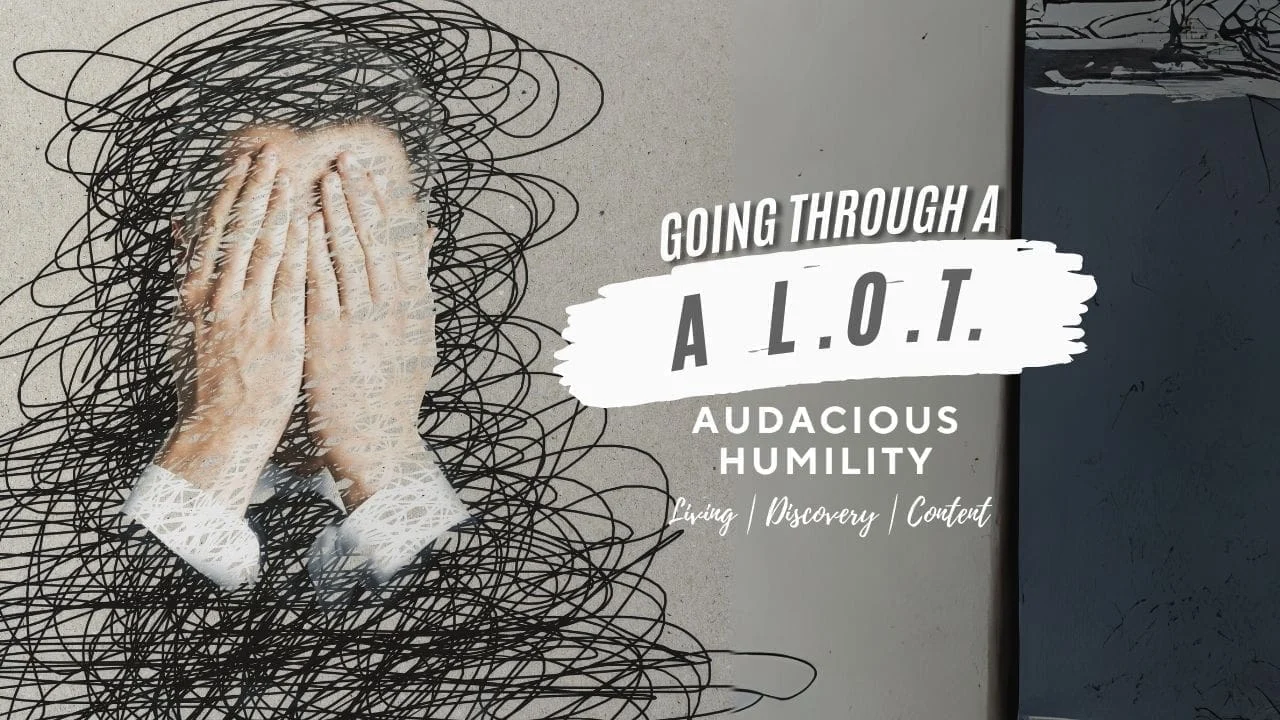
Sometimes, it feels like a massive hurricane; one of emotions, challenges, and experiences. When it happens, we realise that we’re going through a L.O.T. (Lost, Overwhelmed and Tired).
As someone who developed The AHC and as someone who embraces living with Audacious Humility, you would think that I would be immune – right? Well, nope! The truth is, we all go through a L.O.T. and I haven’t been spared of ‘going‘.
I recently found myself feeling a sense of being lost, overwhelmed, and tired. I mean; rewards were delayed, plans went awry, and loved ones faced hardships such as loss. My Higher Self (my authentic core, future self and deepest desires) felt distant. Yet, amidst the L.O.T., I experienced something different this time: a “but I know what I need to do to recover” ‘aha’ moment. It has inspired this short article because a lot of what I’ve shared so far about The AHC can seem abstract, but this personal experience can show you how applying the principles has been useful and helpful in my situation.
Here’s how Audacious Humility helped me weather the storm when I felt like I was going through a LOT:
- Lost & Searching: I reconnected with my Higher Self through the “Connect with Your Higher Self – Unleash Your Potential” exercise. The Audacious Humility Canvas helped me recalibrate and identify what was pulling me off course.
- Overwhelmed & Anxious: Prioritising Health and Well-being was crucial. Despite my initial hesitation, I asked for help, recognising my limitations and the strength vulnerability brings. Interestingly, one of my strengths – wanting to be there for others – was also contributing to my anxiety. It’s a reminder that strengths can become weaknesses if unbalanced.
- Tired & Struggling: Self-Awareness became my anchor. I honestly assessed situations, challenges, and relationships, without judgment, to understand their impact.
Remember: Audacious Humility isn’t a life raft guaranteeing smooth sailing. It’s a navigator’s toolkit for calm and turbulent seas. The seven pillars are your sails, but to truly navigate the storm, you need more:
- Community Engagement: Surround yourself with individuals who embody Light and Kindness, understanding, and support. Their encouragement becomes a steady wind propelling you forward.
- Self-Compassion: Be kind to yourself. Forgive missteps, celebrate progress, and remember that even storms have silver linings. This gentle grace fuels your inner fire and keeps you moving.
My journey won’t always be smooth sailing. Storms still come, and I go through a L.O.T. But now, my AHC isn’t just a tool; it’s a symbol of resilience, reminding me that even when lost, overwhelmed, and tired, my Higher Self remains.
Going through a L.O.T. doesn’t mean you’ve failed. It means you’re human, and your compass is waiting to guide you back. Don’t be afraid to admit when you feel lost. Instead, use that feeling as a signal to reengage your compass. Seek its guidance, nurture its light with self-compassion, and set sail once more.
Remember:
- Even the roughest seas can lead to profound discoveries.
- You are not alone. We are all in this together, navigating our L.O.T.
- Use Audacious Humility as your guide, your light, and your reminder that even in the midst of the storm, you have the strength and resilience to find your way back to your true north.
I invite you to use the AHC to sail the storms of life and to let self-compassion light your way.
After watching a video on YouTube, I was inspired to write this article. The message was something along the lines of “Think like a genius, communicate like a kid”. So, I pencilled this piece, wanting so badly to communicate clearly to you. I hope you enjoy it and please let me know what you think in the comments section or drop me a WhatsApp or e-mail. Here goes…
Have you ever felt like your self-esteem is stuck in a place you don’t like, such as a dim, cold corner? Like your dreams are far; many planets away from you, while your confidence is like a scared character that quivers and flickers like a dying candle? If you feel this way, fortunately, you’re not alone. Millions of us struggle with feeling good about ourselves. We are constantly battling the spooks of self-doubt and insecurity. But you know what? There is a way, a ‘secret key’ if you will, to unlock the treasure vault of self-worth and ignite a fire of venturous confidence.
It is a way of being, an approach to life, a school of thought that is not about dimming your light, but about burning it brighter than ever, fuelled by the very necessary wisdom of compassion and connection. It is the kind of wisdom that doesn’t earn you worldly accolades or badges but opens your eyes to the reality that you can learn every single day of your life if you are humble and open yourself up to the teachings that life will always send your direction. This approach is such a refreshing mix of concepts that you can drink from it daily and add self-esteem to your daily diet.
Some of us even have a negative relationship with the idea of having self-esteem. But perhaps it’s time to begin thinking of this approach as a secret superpower that fuels your self-esteem and empowers you to:
- Chase your dreams with laser focus, knowing you’ve got the inner fire to make them a reality.
- Embrace your unique quirks and flaws, transforming them into badges of authenticity.
- Build rock-solid confidence, not arrogance, and do so not from external validation, but from your own inner fountain of worth.
You might have already guessed it, but we call this self-mastery approach Audacious Humility, and it isn’t a feel-good buzzword; it’s a practical structure. It’s like a roadmap to navigate the terrain of self-doubt and emerge on the other side, basking in the sunshine of self-confidence.
Let’s make it practical; here are the seven pillars of Audacious Humility that guide you on the way to unleash your inner awesome:
1. Stewardship: When you connect to your deepest values, your authentic self, the wellspring of your confidence, your resilience, and your inner fire, you gain freedom from doubt, and you believe in yourself and your abilities. Your confidence begins to overflow. This should be your power source. To unleash your inner awesome and fuel your self-confidence, tap into this power source, and let it guide how you journey towards self-love, self-acceptance, and audacious living. This power source is the kind that urges you to fully embrace audacious living; an approach to life where you gather the courage to dream of a future where you are not afraid to pursue your innermost desires but embrace the mindset that says “Hey! You’re not there yet, but if you are humble enough to learn, bold enough to go for it, disciplined enough to do what it takes, and persistent enough despite the challenges, then you have a chance of getting there. And it’s worth pursuing!” at the same time!
2. Purposeful Living: When it comes to self-esteem, and Audacious Humility as a whole, you need to align with the thinking that you have more than one “why.” When you do this, you immediately embrace what we just mentioned in the core. When you find a ‘why’ for one of the audacious goals or visions that you’re pursuing, you find a guiding star that lights up your soul and gives your endeavours meaning. This isn’t just about personal ambition; it’s about aligning yourself with something bigger than yourself, something that makes your heart sing. It could be more than one thing! With this in your superpower backpack, amazing things happen to you when no one is watching – which is when it matters most – where you’re able to recalibrate your life when things are moving too rapidly, stagnating or everything in between. You’re able to bring yourself back to ‘what am I doing and why am I doing it?’. I promise you; no one needs to hear you say this out loud or even see you do it or know about it, but this level of control can boost your self-esteem so much that others might think you’re ‘on something’.
3. Health and Well-being: Unleash your inner awesome by nurturing your mind, body, spirit, connections, environment, growth, and inner compass. Exercise regularly, eat healthy, prioritise sleep, find ways to de-stress, and work on your finances, nutrition, mental health, emotional well-being, social and community engagement, communication, spiritual well-being, personal values, mindfulness… and the list goes on and on. A healthy you is a confident you, ready to conquer any challenge with a smile. Can you imagine what power you gain by having a grasp on all these things? Even if they are not perfect, you’re just aware of them and have laid out plans (where possible) of where you need them to be in future. Can you see it? Think about what this does to your self-confidence. I can tell you, that it adds a little fire to your soul and takes your self-esteem out of that dark, cold corner.
4. Self-Awareness: One of the things you might discover as you embrace living with Audacious Humility is that everything is connected in this approach. The elements we’ve discussed so far require some level of self-awareness. Right? So, take an honest look at your strengths and weaknesses. Do a SWOT (Strengths, Weaknesses, Opportunities and Threats) analysis of yourself. This could mean, having a ‘meeting’ with yourself where the agenda item is you. Explore yourself, your life, your past, present and future, and look at every element you can bring to your mind in terms of its SWOT. Once you’re done with this exercise, which is not about self-punishment (although it can feel like it), you will gain such a better understanding of yourself that you are in a better position to navigate life’s twists and turns with grace, audacity, excellence, and sometimes even humour; boosting your self-esteem, lighting the fire of your inner awesome!
5. Skills and Knowledge: In light of making things practical, let’s tell the truth – you can learn anything if you really put your mind to it. Of course, some things are harder than others to learn, and some might even seem possible, but I want to say that when you live with Audacious Humility, you will know that it’s not always about what you get, but who you become in the process. So, dare to be a life-long learner. When you realise just how much you don’t know and are not looking for things to pump your ego, you can easily bring yourself to a place of humility. But at the same time, I’m saying, that right after you exercise humility and know that life is an existence of this duality, immediately pump your boldness and audacity to learn something new or better. Continuously learn and grow. Whether it’s mastering a new skill, devouring a book, or attending a workshop, keep your brain buzzing and your curiosity ignited. The humbling thing about being a lifelong learner is that you know that you will never know everything but you can know a lot, and that’s just so nourishing for your self-esteem.
6. Community Impact: The point of living the Audacity Humility includes having an awareness of the world within, around and beyond you. It’s such a simple thing to state but its magnitude cannot be overstated. On the one side of community engagement is knowing that “motho ke motho ka batho”, translated simply “I am because you are”. It’s a basic principle that we are not alone in the world. So, we have a responsibility, to whatever degree, towards others – in our families, communities, or the environment/world at large. Activities and commitments such as volunteering, mentoring, or simply offering a helping hand not only enrich your community but also boost your own sense of purpose and belonging. Let’s stop here for now… but remember; you and the world matter!
7. Relationships: Surround yourself with supportive people who believe in you, push you to better yourself, have compassion, audacity, and humility, and celebrate your victories. Build and create strong connections that are like anchors, keeping you grounded and reminding you of your worth. Be aware of your biases in relationships and understand the value currency in your relationships – whatever nature or form they may take. Just like in health and well-being or self-awareness, implement strategies, tactics and tools to measure, nurture, monitor and develop or maintain your relationships, ensuring that they align to and with your core. They must feed your “whys”. Imagine if all the people or organisations who you would list in your “Relationships and Partnerships’ pillar/element had done the work prescribed in the Audacious Humility way of living. What do you think that would do to your self-esteem? I think it would be awesome, but I’m biased ?
I want to wrap up the article by saying the following:
Remember, Audacious Humility isn’t about perfection; it’s about progress. Every step you take, every challenge you overcome, and every time you choose self-compassion over self-criticism, is a victory for your self-esteem. It may take time, but it’s an adventure work taking. Unleashing your inner awesome is an adventure worth pursuing!
Audacious Humility is a transformative self-mastery approach where the pursuit of excellence, growth, balance and harmony intertwines with bold humility, compassion, and oneness. We create material and content that align with wanting to ignite and connect with our innermost selves, creating an external world that aligns with our innermost desires.
I invite you to join the movement of audacious self-love, share your experiences, ask questions, and connect with me and others in the comments below. Together, let’s build a community where self-esteem shines brighter than ever before!

In today’s hustle and bustle, where constant activity and productivity are often glorified, the importance of rest is often overlooked. We’ve become accustomed to pushing ourselves to the limit, sacrificing our well-being in the pursuit of success. However, this relentless pursuit of achievement comes at a cost. When we don’t prioritise rest, we become more susceptible to stress, burnout, and even illness.
In this “Dare to Rest” episode of An Audience of One, I explore the concept of rest and its profound impact on our lives. I delve into the challenges of recognising the need for rest, especially when we’re conditioned to constantly push through. I also discuss the difference between resting and giving up, emphasising that rest is not a sign of weakness but an act of self-care that allows us to replenish our physical and mental resources.
Rest is Not Surrender
The decision to rest may feel like giving up, especially when you’re accustomed to constantly pushing through challenges. This is because rest can trigger feelings of guilt, shame, and inadequacy. However, it’s crucial to remember that rest is not a sign of weakness; it’s an essential part of self-care that allows you to function at your best.
Resting allows your body to repair and rejuvenate itself, improving your physical and mental health. It also enhances your productivity, focus, and creativity, enabling you to tackle challenges with renewed energy and resilience.
10 Tips to Embrace Restful Rejuvenation
- Tune into your body’s signals. Pay attention to the subtle cues that indicate you need rest, such as fatigue, irritability, difficulty concentrating, and decreased productivity.
- Schedule rest into your daily routine. Just as you schedule work and other commitments, make time for rest a non-negotiable part of your day.
- Create a relaxing environment for rest. Find a quiet space in your home, dim the lights, and put away electronic devices to foster a calming atmosphere.
- Discover activities that help you unwind. Engage in activities that promote relaxation, such as reading, taking a warm bath, listening to soothing music, or spending time in nature.
- Avoid caffeine and alcohol before bed. These substances can disrupt your sleep patterns and hinder restful slumber.
- Prioritise a good night’s sleep. Aim for 7-8 hours of sleep each night to allow your body to fully rest and recharge.
- Practice saying no. It’s perfectly acceptable to decline invitations or commitments that drain your energy and prevent you from prioritising rest.
- Embrace delegation. Don’t hesitate to delegate tasks to others to free up time for yourself to rest and recharge.
- Incorporate regular breaks throughout the day. Take a few minutes every 30-60 minutes to step away from your work and get some movement.
- Be patient with yourself. Learning to rest effectively takes time and practice. Be kind to yourself and gradually incorporate rest into your daily routine.
The Benefits of Rest
- Improved physical health and reduced risk of illness
- Reduced stress and anxiety levels
- Increased energy levels and stamina
- Enhanced mental clarity and focus
- Boosted creativity and problem-solving abilities
- Strengthened relationships and emotional well-being
Resting is an Act of Strength
Taking time for rest is not a sign of weakness; it’s a testament to your strength and self-awareness. It demonstrates your commitment to your well-being and acknowledges that rest is not a luxury but a necessity for a fulfilling and healthy life.
Listen to your body’s signals, prioritise rest, and experience the transformative power of self-care. Embrace rest as a bold act of self-love and watch your life flourish with renewed energy, resilience, and well-being.