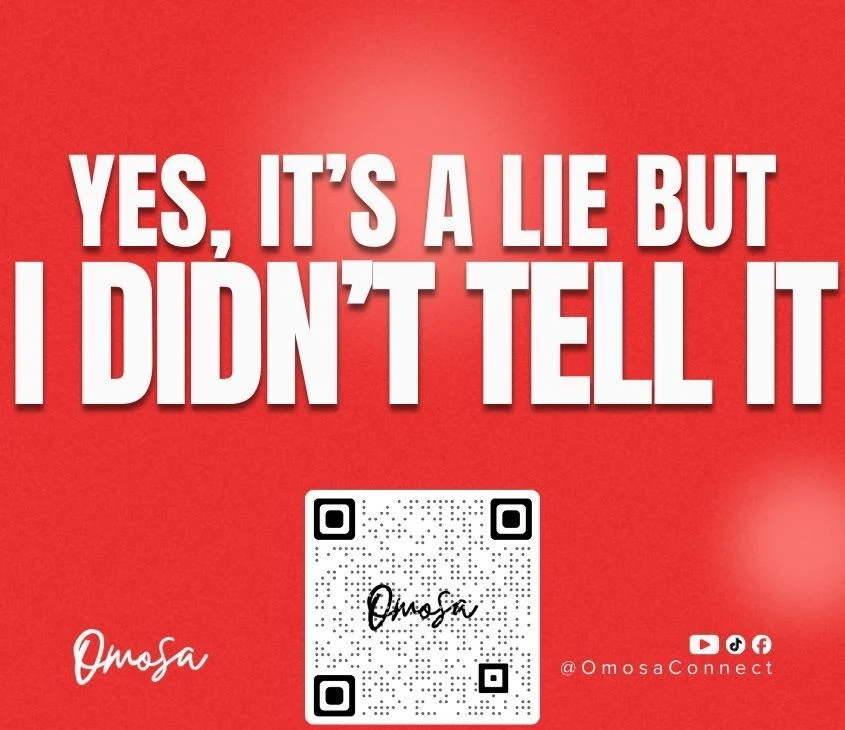


Yes, it's a lie but I didn't tell it.
Language is dangerous because it is efficient.
We, people, like efficiency. We like shortcuts. But sometimes, those shortcuts hide sinister things right under our noses.
What if our trauma or ‘common sense’ - individual or collective - isn't the truth? What if we have become so complacent in ruining our own relationships simply because we’ve overlooked the potency and importance of the words we use and the language we conduct?
Let me share...
Last week, I hit a wall. I was navigating triggers across a wide spectrum of my life - family, professional, personal development, historic racial dynamics, the whole lot. But one specific moment stopped me cold.
It was the phrase: “I'll try.”
When I played it back, it wasn't a lie. It was someone probably being authentic. They may have genuinely meant, “I am going to give this my absolute best effort.” It’s possible that their heart was in the right place.
But to me listening? It was a lie.
I felt that “I'll try” is a loophole. It leaves the back door open. It prioritises their safety over my peace.
Compare that to: “I commit to this.”
When you say “I commit,” the atmosphere in the room changes. The anxiety dissipates. The other person has something solid to hold onto. “I’ll try” is a defense mechanism. “I commit” is a connection and communication bridge.
Of course, it is not always easy to say “I commit.” It feels risky. But we should also realise that by choosing the “safer” phrase, and depending on who is listening and how they are listening, we may inadvertently be choosing comfort over connection.
When they said “I will try”, and all I heard was “I am not committing”, wouldn’t it be fair for them to say: “Yes, it's a lie, but I didn't tell it.”
What we might be dealing with
This paradox is where relationships go to die. We think we are communicating, but we are actually just triggering each other.
I started looking at the other phrases we use on autopilot. It’s not just the big ones; it’s the filler words that carry hidden daggers:
- “We need to talk.” (The universal signal for impending doom).
- “But...” (The word that instantly deletes whatever affirmation came before it).
- “I thought so.” (The subtle art of proving someone wrong).
- “Literally.” (The exaggeration that erodes trust in our precision).
- “You know what I mean?” (The lazy request for the other person to do the emotional labour of understanding you).
- “What do you mean?” (Often heard not as curiosity, but as a challenge).
- “I am just saying.” (The shield we use after throwing a spear).
We are speaking a corrupted language. We are transmitting one signal (Intent), but the other person is receiving a completely different signal (Impact) based on their internal dictionary of past wounds, traumas and other experiences.
This is Collective Social Trauma.
We have allowed these glitches and distortions to words and language to run rampant. We have accepted that “I'm fine” is a socially acceptable lie, and that “ASAP” is a reasonable way to induce panic in a subordinate.
It’s Just Food for Thought (It’s Just F4T – It’s Just Effort)
So here’s a thought - should we be more interested in what happens when we become aware of the effects of collective social trauma on language and communication?
Perhaps when someone says “I’ll try,” we should recognise their vulnerability in the moment. Perhaps when someone says “ASAP,” they don’t mean “now” - they just mean they are anxious.
Perhaps we could learn to speak in a way that communicates our truths. And learn to listen in a way that hears others’ truths and not our own traumas.
I would really love to connect with you on this topic this week. Let’s engage on Omosa Connect.
Peace be with you. One, Perfect Love.