

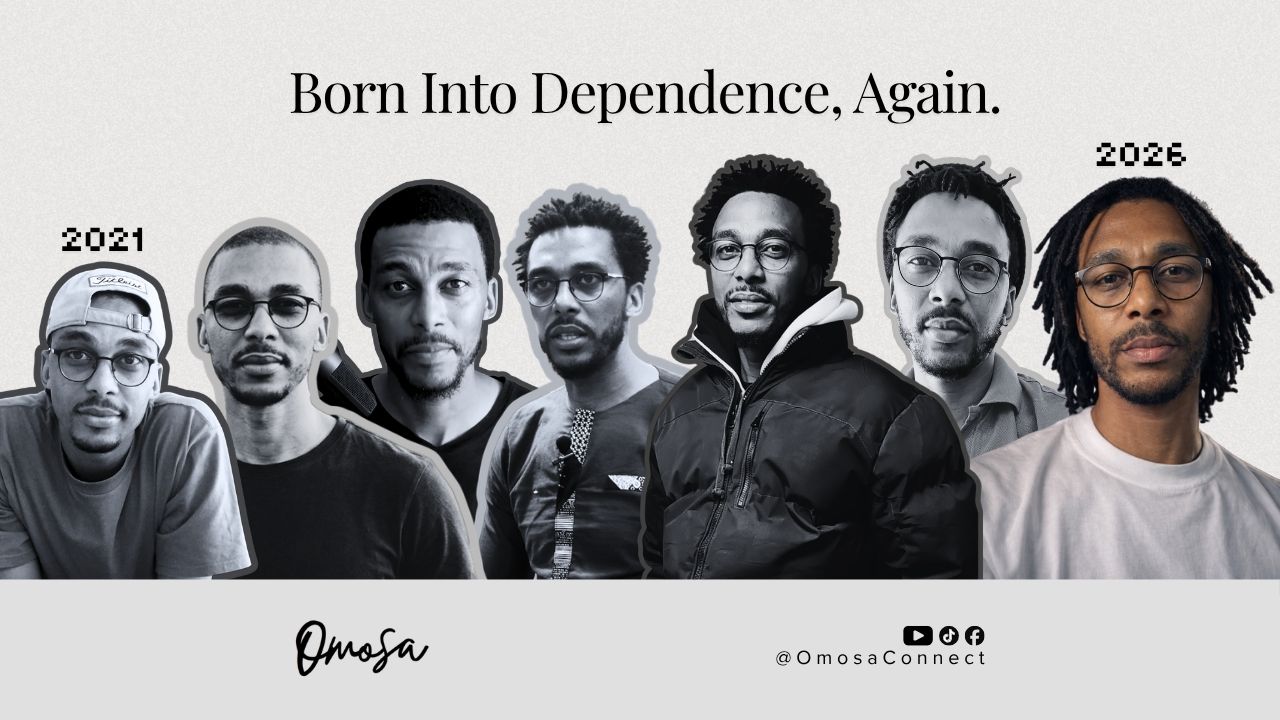

Born Into Dependence, Again.
One of the hardest things I have had to unlearn is the expectation that someone will always be there with me – and more imprisoning still, there for me – whether in guidance, help, provision, or protection.
Being the fifth and last among five, I was born into dependence before I was old enough to name it. I did not choose it. And in a way I am only now beginning to understand, that was not the only time. That is why I can no longer speak about this merely emotionally.
Because here’s my opinion – many of us spend years thinking we are dealing with habits, when in truth we are dealing with formation. We think we are wrestling with quirks, tendencies, preferences, or personality. But often we are dealing with something much older and deeper: an early system of conditioning that shaped us long before we had language for it, long before we had theology for it, and long before we had enough self-awareness to question it.
What we later call “just the way I am” is sometimes simply what got repeated around us long enough to feel natural. The family system teaches before language does.
That is why I have become cautious of shallow conversations about birth order. At first it was a reaction – because I am “the last born” at home. Over time, I have come to know and accept that popular culture loves easy labels: the responsible oldest, the forgotten middle child, the spoiled youngest. But life is more serious than that.
The deeper issue I am addressing with this journal is not stereotype. The deeper issue is formation.
Here are some things to consider
A later-born child does not arrive into an empty world. They arrive into a world already interpreted.
They are born after the emotional climate has already formed. They are born after the family has already developed patterns, hierarchies, tensions, habits, reflexes, ways of explaining, protecting, correcting, comforting, and carrying. The house already has a logic. It already knows who speaks first, who notices most, who intervenes, who shoulders burdens, who gets shielded, who gets corrected, who gets leaned on.
So the younger child is not simply meeting parents. They are meeting a living system. And that system is already teaching.
Consciously, the younger child may receive more guidance, more explanation, more help, more correction, more attention, or more carrying. Unconsciously, something deeper is taking root: help is near. Support is accessible. Someone stronger is in the room. If I do not know, someone will explain. If I am in danger, someone will step in.
That does not require bad parenting. It does not even require excess. It only has to be repeated enough to become part of the child’s reading of reality. And once an expectation is repeated early enough, it no longer feels like expectation. It feels like the world.
Another thing is that the same house is not the same childhood
This is where family dynamics become more powerful than most people realise.
A child is not formed only by what they are told. A child is formed by what is normal around them. By who had to grow up early. By who was allowed to remain soft longer. By who was made an example. By who was shielded from consequences. By who helped carry whom. By whether the family had money then or not yet. By whether the parents were still fresh, hopeful, exhausted, wounded, stretched, or seasoned by the time that child arrived. So when people say, “But all siblings grew up in the same house,” I hear that differently. The same house is not the same childhood.
One sibling may have known their parents in years of pressure, another in years of stability. One may have received stricter handling, another softer treatment. One may have grown up under financial lack, another under improved provision. One may have encountered youthful intensity, another mature calm, another tired depletion.
The parents may be the same in name, but they are not static human beings.
- Time changes people.
- Stress changes people.
- Marriage changes people.
- Money changes people.
- Grief changes people.
- Growth changes people.
So no, siblings do not always grow up with the same parents in the way people casually mean it. They often grow up with different versions of the same parents, in different seasons of the same family. And that leaves marks.
The marks it leaves
These marks often remain invisible because they look ordinary.
In work, a person shaped by the nearness of help may look intelligent, capable, and full of potential, yet still struggle to move without enough clarity, reassurance, or external confirmation. They may wait too long. Consult too much. Escalate too quickly. Delay not because they are lazy, but because some part of them still expects interpretation to come from outside. Or, if they become angry at that pattern, they may swing to the opposite extreme and become allergic to help, resistant to collaboration, and quietly exhausted from trying to prove they need no one.
In relationships, the same formation can become more intimate and more painful. A person may unconsciously link love with steady rescue, guidance, emotional covering, or practical support. They may not look demanding, but they feel destabilised when care is absent, inconsistent, delayed, or unclear.
Another person, reacting against that possibility, may reject help altogether. For them, receiving feels humiliating, asking feels threatening, and vulnerability feels unsafe.
- One expects too much.
- Another expects nothing.
- Both are still being shaped by a buried architecture of formation.
Even spiritual life can be distorted by this. One person calls passivity “trusting God.” Another calls isolation “maturity.” One never fully grows up because they keep waiting to be carried. Another never fully softens because they are determined never to need carrying again. In both cases, spiritual language can become a cover for unresolved formation.
A little more mercy for ordinary people
And perhaps that is why ordinary people deserve more compassion than they usually receive. Many adults are not simply weak, spoiled, hard, controlling, or cold. Many are living from invisible early scripts. Their nervous systems learned the world before their minds could examine it. Their expectations were trained by repetition. Their instincts were coached by role. Their emotional reflexes were formed through years of living in a particular position inside a family system.
What we call personality is sometimes partly positioning made familiar. This should also make siblings more humble with one another.
The older sibling may need to realise that what they call irresponsibility in the younger may partly be the fruit of a system where help was always near. The younger sibling may need to realise that what they call hardness or control in the older may partly be the fruit of responsibility arriving too early.
- One may have known burden before tenderness.
- Another may have known tenderness before burden.
- One may have learned, “No one is coming.”
- Another may have learned, “Someone always will.”
If siblings meet each other only at the level of behaviour, they may resent each other for years. But if they begin to understand formation, they may finally gain wisdom.
When I could no longer call it personality
That is what started happening to me. Once I began to see this, I could no longer reduce my struggle to attitude. I could no longer tell myself that I simply needed to toughen up or stop assuming things. I had to face something deeper: I had been formed inside an expectation structure.
Not merely an emotional tendency, but an entire inner architecture that quietly assumed help would be near, guidance would come, support would appear, and someone would be there for me.
Because it was old, it did not feel like belief. It felt like reality. And that realisation made me think differently about formation. At first, after confusion, my instinctive response was anger. Because when you first see a hidden pattern in yourself, especially one that seems to have limited your growth, the temptation is to revolt against it. If dependence shaped me, then I must become fiercely independent. If I expected too much, then I must expect nothing. If I was softened by support, then I must harden myself against all help. But reaction is not freedom.
Reaction is often just the old pattern in reverse. It still lets the past set the terms. It still lets earlier formation dictate present behaviour. It still says, “You will define me,” even if only by opposition. To reject all help is not necessarily maturity. Sometimes it is damaged dependence dressed in self-sufficiency.
Not reaction, but response
That is where Grace-aligned systems thinking is helping me. It is teaching me that transformation is deeper than reversal. The opposite of distortion is not automatically truth. The opposite of dependence is not necessarily freedom. Sometimes it is simply the same bondage wearing a new face. And that is when I realised that a new form of me had to be born. Not as a reaction, but as a response.
That distinction matters deeply to me now.
Reaction is governed by injury.
Response is governed by truth.
Reaction says, “Never again.”
Response says, “I understand what formed me, but I will not let it rule me.”
Reaction makes anger the architect.
Response lets truth do the building.
What I needed was not a harder personality. I needed a truer formation.
I needed to become someone who could acknowledge the tenderness of my beginnings without remaining imprisoned by them. Someone who could see how I had been shaped without making that shape final. Someone who could refuse both childish dependence and theatrical independence. Someone who could grow in responsibility without becoming brittle. Someone who could receive help without worshipping it, and trust God without using Him as an excuse for passivity.
That is not easy work.
It requires a person to hold compassion and responsibility at the same time. To be gentle enough to understand the child they were, and honest enough not to let that child rule the adult they must become.
So this is the truth as I know it now: I did not choose my family position. But my family position shaped me. It taught me sweet things. It also taught me imprisoning things.
And once I saw that, I could not go back.
Born into dependence, again
And yet, here is the tension I have had to come to terms with: the goal was never to eliminate dependence.
That was my mistake at first.
When I began to see how deeply I had been formed by unconscious dependence, my instinct was to destroy it completely. To become someone who needs nothing. Someone who expects nothing. Someone who relies on no one. Someone who stands alone.
But that is not maturity. That is reaction. Because the opposite of dependence is not freedom. It is often isolation. And isolation, no matter how strong it looks, is still a distortion.
The deeper truth is this: I was not created to live without dependence. I was created to live with right dependence. So the journey was not from dependence to independence.
It was from unconscious dependence on people to conscious dependence on God.
That changes everything.
Because now, I no longer expect people to be my source. I no longer place on them the weight they were never meant to carry. I no longer interpret their absence as collapse. I no longer confuse their presence with provision itself.
But I also no longer reject them.
- I can receive guidance without worshipping it.
- I can receive help without depending on it.
- I can receive provision without being shaped by it.
- I can receive protection without expecting it.
Because my dependence has been reordered. Not removed. Redeemed.
And perhaps this is where the language of being born again becomes real beyond theology.
I see it now: I was born into a dependence I did not choose. A dependence that shaped my expectations before I understood them. But I am being born again into dependence – a dependence I am now choosing. Not on people. Not on systems. Not on arrangement. On God.
Born once, I inherited a formation. Born again, I step into one.
Born once, I learned to expect from what was around me. Born again, I learn to trust the One above me.
So no, I did not escape dependence. I entered it again.
But this time, it is not unconscious. It is not imprisoning. It is not misplaced. It is aligned. It is chosen. It is true.
Not passive. Not demanding. Not brittle. Not theatrically independent. Not secretly waiting for rescue. Not angry at every offer of help.
But responsive.
- Responsive to truth.
- Responsive to responsibility.
- Responsive to grace.
- Responsive to reality.
- Responsive to God.
And perhaps that is one of the deepest questions we can ask of ourselves:
- What first trained me to expect what I now call normal?
- What shaped my reflexes?
- What taught me how to read closeness, help, provision, or absence?
- What in me is conviction, and what in me is old formation made familiar?
There is too much unnecessary shame in the world because people are fighting patterns they have never properly named. There is also too much unnecessary pride because people mistake what came easiest to them for virtue, when sometimes it was simply positioning.
To understand formation is to become humbler.
Some strengths were scaffolded.
Some weaknesses were conditioned.
Some fears were trained.
Some burdens arrived early.
Some comforts felt natural only because they were ambient for so long.
I did not choose to be born into dependence. But I can choose not to remain unconsciously governed by it. And I can choose not to become its violent opposite either. I can choose response over reaction. I can choose to be born into dependence, again.
One, Perfect Love.