


Can I talk to men for a minute?
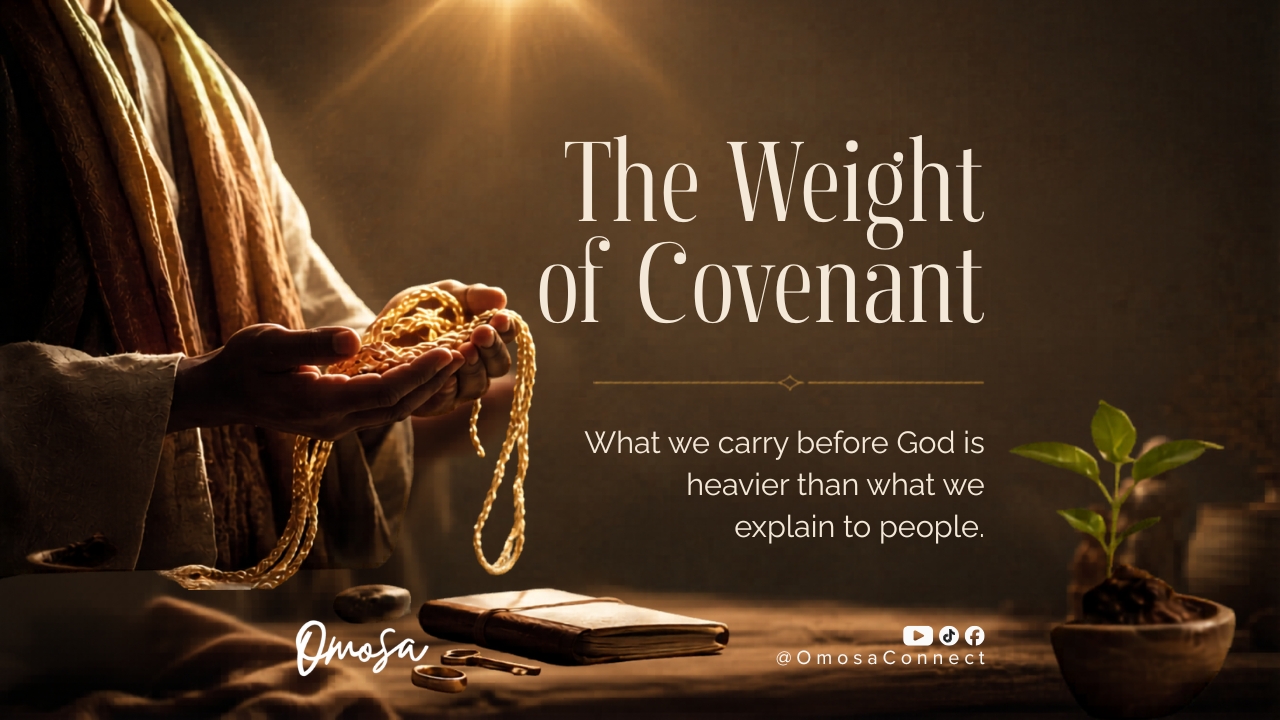
Gentlemen, what we carry before God is heavier than what we explain to people, or even convince ourselves of. In this 3-part series, covenant is the heaviest topic for me because I went through a phase of self-condemnation, which, I believe, God used in my life to teach me the gift of grace. And on that note, let me get this out of the way: I am not married. I do not have children. I am single and, by some of the world’s standards, I am neither rich nor successful. So, if these place me in the box of people you would listen to, please feel free to give this article a kind skip. I apologise for the drama and directness. It is only that I want to talk to people who want to listen and are willing to listen. Truly listen.
Okay. The ground has been established, so here goes…
I have been thinking about Covenant from my personal experiences and as a broader spiritual reality. The sacred seriousness of what we promise, what we accept, what we carry, what we build, what we touch, what we lead, what we steward, and what we say yes to before God. The thing is, Covenant is one of those words that can sound old, religious, ceremonial, or distant, only until life reveals its weight. Then, suddenly, it is no longer abstract. It stops merely being a word used in vows, sermons, contracts, rituals, family meetings, strategy documents, prayers, weddings, ordinations, business launches, friendship promises, community commitments, or personal declarations. It becomes a mirror. It becomes a witness.
It becomes the place where God asks: “Did you understand what you were carrying?”
That question is for every entrusted thing. When you adopt the mindset that you are entrusted, things begin to look different.
- A child is not a project.
- A spouse is not an accessory.
- A friend is not an emotional convenience.
- A team is not a productivity machine.
- A pulpit is not merely an audience.
- A calling is not a brand.
- A marriage is not a relationship goal.
- A gift or talent is not a performance tool.
- A community is not a market segment.
- A promise is not content.
- A person is not a stepping stone.
A child may remember your tone long after you have forgotten the moment. A spouse may learn not to expect tenderness if it arrives only when it is convenient. A friend may trust you with one fragile truth and discover, by how you carry it, whether they were safe with you. These are Covenant territory. What God entrusts to us carries weight.
And one of the great dangers of modern life is that we often treat covenantal things transactionally. What this means, for example, is that we can treat sacred responsibilities as ‘arrangements’, people as ‘roles’, and keep commitments just as long as they remain emotionally rewarding to us. We can treat callings as public validation, and faithfulness as something we keep only as long as it does not inconvenience the self we are trying to protect.
Then, when something breaks, we search for an explanation that feels reasonable enough to survive public scrutiny and private discomfort. But Covenant does not only ask whether the explanation makes sense. Covenant asks whether we were faithful with what was entrusted. That is a different kind of question. And I will say one other thing: if you do not pause to think differently about that question, then what I am writing about here will just remain words to you.
We ought to think differently about covenants than we do about contracts. A contract can ask, “Were the terms met?” But a covenant asks deeper questions, and it asks them differently. A covenant can ask: “Was the sacred trust honoured?” A contract can ask, “Who breached?” A covenant asks, “What did love require?” A contract can ask, “What are my rights?” A covenant asks, “What was my responsibility before God?” A contract can protect interests. A covenant exposes the heart. A contract may tell us what we can demand. A covenant asks what we must carry. A contract may protect the arrangement. A covenant asks whether the person was handled with reverence within the arrangement. I am not implying that contracts are bad. No, not at all. We need agreements, structure, law, accountability, clarity, boundaries, signatures, consequences, and wise administration. Stewardship, after all, is not carelessness dressed as spirituality. But Covenant goes deeper than enforceable terms and the tic-tac-toe of who was wrong and who was right between two people. Covenant carries the invisible seriousness of having made a commitment before God, whether people saw it or not.
Marriage is such a powerful example because when a man and a woman stand before God and make vows, they are not merely entering a romantic partnership. They are not only announcing affection. They are not only combining households, families, dreams, histories, bodies, bank accounts, cultures, and futures. They are not simply choosing a person they prefer over other people. They are standing inside a sacred seriousness. They are making a vow that touches spirit, body, name, memory, family, future, and ultimately God. That is why, when marriage breaks, the pain is not only emotional. It is not only social. It is not only legal. It is not only financial. It is not only psychological. It is spiritual. Something covenantal has been wounded. And this is where I often find myself speaking carefully, again, especially to men, because there is a private reckoning that no public explanation can replace.
There may come a moment when there is no one else in the room. Just you and God. ‘Face-to-face’. No friend to convince that you were right. No family member to satisfy. No community to persuade. No image to protect. No clever arrangement of facts. No “but they also…” No performance of innocence. No audience.
At this point in the article, I invite you to study the story of David, son of Jesse and father of Solomon. After you have, you will come to know that when you are in that place, in that moment, the question becomes heavier than “Can I explain what happened?”
They become:
- “Was I faithful?”
- “Did I protect what you entrusted to me?”
- “Did I love, or did I only want to be loved?”
- “Did I serve, or did I only want to be served?”
- “Did I lead with humility, or did I hide behind authority?”
- “Did I tell the truth, or did I only tell the version I could survive?”
- “Did I use my pain as permission to become careless?”
- “Did I hear where you were asking me to repent?”
- “Did I call something peace because I was tired of obedience?”
That encounter can be wrenching. And trust me, it is something you want to prevent at all costs. Not because God is cruel. Because truth is clean. In that moment, truth cuts through your performance. It cuts through the stories we rehearse until they sound holy. It cuts through our selective memory. It cuts through the small lies we tell in order to remain the hero, the victim, the misunderstood one, the mature one, the spiritual one, the one who tried everything, the one who had no choice. Sometimes truth feels severe because we have spent so much time negotiating with ourselves. But marriage is not the only place where covenant reveals us. It is simply one of the clearest mirrors. The same weight shows up wherever God places people, responsibility, influence, words, or trust in our hands.
There are also covenants in leadership – When people are placed under our influence, something sacred is happening. Leadership is not only the management of tasks. It is the stewardship of people, trust, direction, consequence, and atmosphere. A leader can build systems and still break souls. A leader can achieve targets and still violate Covenant. A leader can speak about excellence while treating people as tools. Someone can go home lighter because you led well. Someone can go home smaller because you needed to feel powerful. God sees both.
There are covenants in friendship – A friend is not just someone who entertains our loneliness. Friendship carries witness, presence, truth, confidentiality, care, correction, celebration, and endurance. To be someone’s friend is to carry parts of their life that should not be handled casually. A friend may give you their secret, their shame, their fear, their confusion, or their hope. What you do with that trust may either give them courage or teach them to close.
There are covenants in parenting – A child does not choose the world they are born into. To parent is to receive a life that is not owned, but entrusted. The child is not our second chance at greatness. The child is not our emotional compensation. The child is not a mirror for our image. The child is a life before God.
And sometimes the covenant is not only in the big provision, the school fees, the clothes, or the roof over their head. Sometimes it is in the way they hear their name in your mouth. Sometimes it is in whether your presence feels like shelter or weather.
There are covenants in work – Not every job is a calling in the dramatic way we sometimes use that word, but every honest responsibility can become a place of stewardship. If people depend on our diligence, if decisions carry consequences, if resources are placed in our hands, if our work affects households, futures, communities, or public trust, then our work is not spiritually neutral. There is a way to do ordinary work as though God is not watching, and there is a way to send one email, make one call, sign one document, or keep one promise as though someone’s life may be touched by your obedience.
There are covenants in business – A client is not merely revenue. A supplier is not merely a lever. A partner is not merely access. An employee is not merely capacity. A community is not merely a market. Money does not remove God from the room. If anything, money often reveals whether God was truly in the room. The invoice, the tender, the salary, the promise to deliver, the way we speak when the client cannot hear us, the way we treat people who need us more than we need them – these things may look administrative, but they can reveal worship or expose pride.
There are covenants in ministry and public faith – If we speak in God’s name, teach in God’s name, encourage in God’s name, build community in God’s name, and invite people into formation in God’s name, we must tremble a little. Not with paralysis, but with reverence. People may bring us their trust. Their questions. Their pain. Their hope. Their confusion. Their desire to be changed. That is not content engagement. That is holy responsibility. A person may read one sentence and finally have language for something they have carried for years. Another person may trust us because we used God’s name. That should sober us.
There are covenants even in words – We often underestimate what we said because we said it in a moment. But words can become shelter or injury. Words can bind, release, bless, curse, promise, mislead, heal, or haunt. A careless promise can create covenantal expectation in another person’s heart. Words become rooms people live in. Some people are still living inside a sentence someone said to them when the speaker had already moved on.
So all these examples are not separate ideas – they are different rooms in the same house. Leadership, friendship, parenting, work, business, ministry, and words all ask the same covenantal question: “What has God entrusted to me that I have treated as if it were casual?” That question, paid the right attention, reaches far. It reaches into how I speak, lead, love, build, apologise, leave, and stay. It reaches into how I handle people who cannot reward me, and people who can expose me. It reaches into how I handle power, grace, celebration, reprimand, disappointment, and misunderstanding. It reaches into how I handle the gap between what I promised and what I became.
Covenant asks for more than intention.
Many people mean well. Many people began sincerely. Many others meant what they said when they said it. But Covenant is not carried by the emotion of the day it was made. It is carried by faithfulness after the emotion changes. And that is why, exactly why, covenant is heavy.
Because there will be days when the feeling that surrounded the promise is gone, and only the promise remains. There will be days when the person, work, community, calling, family, friendship, or responsibility is no longer giving back what it once gave. There will be days when obedience feels less inspiring than the testimony of obedience sounded. There will be days when the sacred becomes ordinary, and the ordinary will test whether it was truly sacred to us. That is often where Covenant is revealed.
It is not revealed at the altar only, or at the announcement, launch, or public commitment only; but in the hidden middle.
- In the unseen carrying of heavy weight.
- In the demand for private discipline.
- In the correction that nobody applauds.
- In the apology nobody posts.
- In the restraint that nobody celebrates.
- In the responsibility nobody claps for.
- In the decision to remain truthful when a cleaner story is available to keep your image untouched.
- In the tiredness nobody sees.
- In the message you choose not to send because it would wound more than it would heal.
- In the quiet return to what you promised, long after the excitement that surrounded the promise has left the room.
The hidden middle is where the entrusted thing either gets protected or quietly neglected. Covenant is in the hidden middle, where you must make the decision to protect what God entrusted to you, even when no one would know if you became careless. This is where Covenant meets stewardship.
If you are new to the Omosa Weekly Journal, you might not know that stewardship is at the heart of this community. Stewardship, even in the context of Covenant, says: “This is not mine in the way ownership tempts me to believe. This has been entrusted.” Covenant says: “And because it has been entrusted before God, I must carry it with reverence.”
It does not mean every covenantal responsibility continues in the same form forever. Some relationships end. Some assignments are closed. Some partnerships must be dissolved. Some environments become unsafe. Some doors close. Some seasons are completed. Some structures cannot be repaired. Some forms of staying are not faithfulness, but fear. Wisdom matters. Safety matters. Truth matters. Justice matters. Mercy matters.
But even when something must end, I say to all of you, especially men, remember that the covenantal question remains: “Did I end this truthfully before God?” Not perfectly. Truthfully. This, and nothing lesser, must be your standard.
There is a difference between that approach and feigning perfection. Perfection performs. Truthfulness surrenders. Perfection tries to make the story untouchable. Truthfulness allows God to touch even the parts of the story we would rather defend. That is the weight of Covenant. It does not allow me to reduce sacred things to whether I can win the explanation. It does not allow me to treat people as supporting characters in the story of my growth. It does not allow me to use God to make my past sound cleaner than it was. It does not allow me to confuse being hurt with being innocent. It does not allow me to confuse being right with being faithful. It does not allow me to confuse being chosen with being prepared. It does not allow me to confuse having a platform with having permission to handle souls casually. Covenant brings us back to God as the truthful and rightful Witness. The One before whom I made promises, accepted responsibility, received gifts, entered relationships, carried names, spoke words, touched lives, and built things.
Conclusion
My conclusion is a prayer that I invite you to say with me:
Most High God, Great King and Lord of the universe, I pray that You help me and my brothers and sisters, especially us men, to understand what we are carrying. Help us not to treat lightly what You entrusted to us in seriousness. Help us not to call something ours when it is first Yours. Help us not to manage people when You asked us to steward them. Help us not to use calling as a costume. Help us not to turn covenant into convenience. Help us not to wait until something breaks before we respect its weight. And when we have failed, help us stand before You truthfully enough to be corrected, humbled, forgiven, restored, and formed. Because the goal is not to live afraid of covenant. The goal is to live awake to it. Awake to the sacredness of people. Awake to the seriousness of words. Awake to the dignity of work. Awake to the holiness of promises. Awake to the stewardship of influence. Awake to the fact that what we carry before God is heavier than what we explain to people. In faith, and through Christ, I believe that You will reveal to me the steps I must take to be in right standing, firstly with You, and with the covenants I have entered. Guide my steps so that my actions reflect Your holiness and not my pride. Amen.
Whatever you do today, may it be pleasing to God.
One, Perfect Love.