

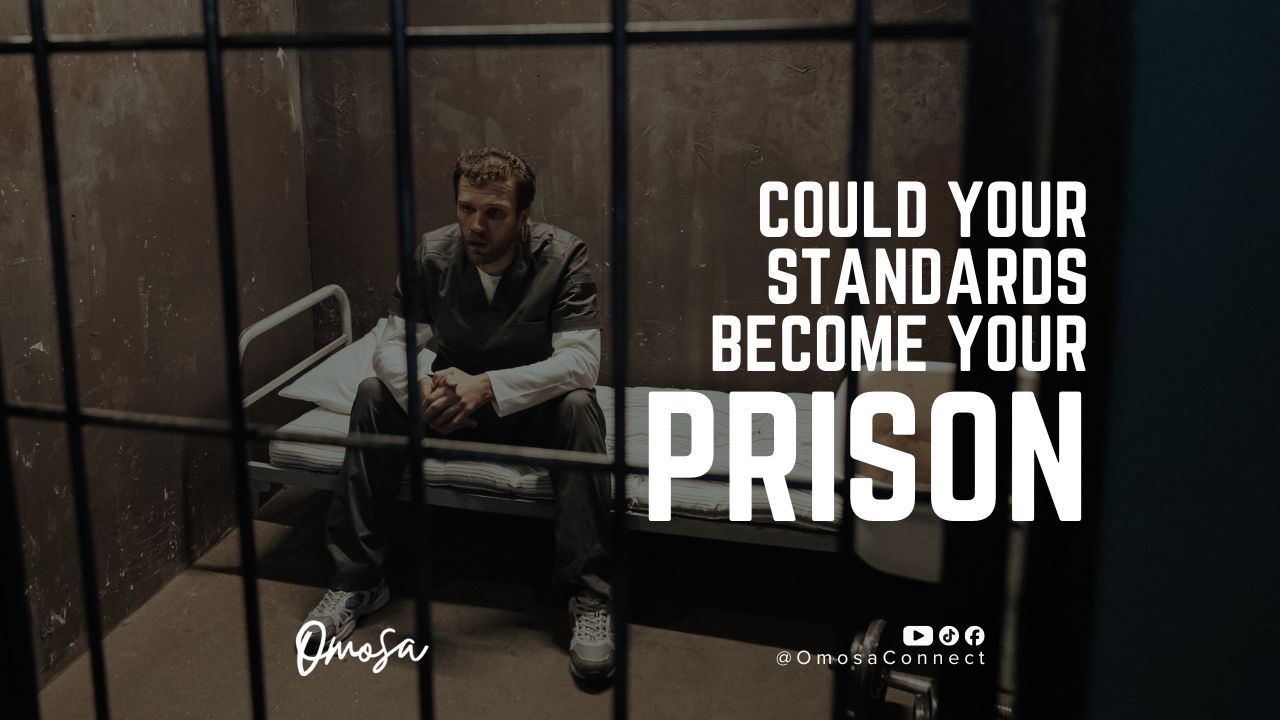

There’s a strange pain I’ve been noticing. Not the kind that is similar to the pain of failure, but the pain of trying to do things “right.” Strange thought. Right?
Doing things right is, firstly, the implicit or explicit acknowledgement that there is a right and wrong to consider in the first place. Then it’s about the right things guiding you. And they are supposed to keep you clean. This is something we might call standards. Because standards are supposed to help you grow. But sometimes… quietly… the same standards that built you start binding you.
And the hardest part is: it doesn’t look like a problem. It looks like discipline. It looks like excellence. It looks like “I just care.” Until you notice the cost.
You’re doing well… but you’re not okay.
You’re productive… but you’re tight inside.
You’re improving… but you’re losing joy.
So here’s the question I’ve been sitting with: When did my standards stop being a tool… and start becoming a prison?
Two words we assume we understand
Before we go further, it helps to define the words because we often hear them as “obviously good” and “obviously bad,” when real life is more layered.
Standards can mean:
- A compass: “this is the quality and character I’m aiming for.”
- A boundary: “this is what I will and won’t allow.”
- A mirror: “this is what I use to measure my worth.” (dangerous when it becomes identity)
- A mask: “this is the language I use to justify exclusion, harshness, or control.” (this happens more than we admit)
And prison can mean:
- A cage of fear: “if I mess up, I’m finished.”
- A cycle of shame: “I’m never enough, so I must keep proving.”
- A control room: “I must keep everything perfect or I’m unsafe.”
- A social weapon: “I’m ‘just keeping standards,’ while I’m actually being toxic, elitist, or unloving.”
That’s why I’m careful with the word “standards.” We tend to hear it and automatically assume it’s righteous. But a person can hide cruelty behind “standards”. A person can hide superiority behind “high standards.” A person can exclude others, shame others, and call it “principle.”
So the question isn’t simply: Do you have standards? The question is: What are your standards producing?
What it looks like in real life
It usually doesn’t announce itself as “unhealthy.” It shows up like this:
- You can’t rest without guilt.
- A mistake feels bigger than it is.
- A slow season feels like you’re failing.
- You keep moving the goalpost, so you never arrive.
- You’re harder on yourself than you’d ever be on someone you love.
- You keep thinking, “When I finally get it right, then I’ll breathe.”
And it can show up socially too:
- “My standards” becomes an excuse for being cold.
- “I just don’t tolerate nonsense” becomes permission to humiliate.
- “I’m protecting my peace” becomes avoidance with spiritual vocabulary.
- “I’m just being honest” becomes cruelty without tenderness.
So the not-so-obvious part is this: Sometimes the pressure isn’t coming from the work. It’s coming from what the work is supposed to prove.
The many reasons standards become prisons
I’ve realised this can happen for different reasons and seeing the reason matters, because it removes judgement.
- Sometimes standards become a prison because life once felt chaotic, and excellence became your way of creating safety.
- Sometimes standards become a prison because you don’t just want to do well- you want to avoid criticism.
- Sometimes standards become a prison because you learned love as performance: “If I do well, I’ll be accepted.”
- Sometimes standards become a prison because you’re trying to control outcomes in a world that refuses to be controlled.
- And sometimes… it’s simply because your standards became your identity.
So a bad day isn’t just a bad day. It’s a verdict.
A sober test
Here’s a simple way to check whether standards are serving you or ruling you: When you think about your standards, do you feel clarity… or fear?
Because godly standards don’t only produce output. They produce peace. They produce honesty. They produce humility. They leave room for repair. But when standards become unhealthy, they produce:
panic, hiding, harsh self-talk, comparison, exhaustion. Not because you’re weak. Because something is governing you.
Stewardship isn’t about lowering your standards. It about re-ordering them
Let me say this plainly: I’m not anti-excellence. Stewardship actually demands excellence – faithful and excellent handling of what’s entrusted. But stewardship refuses one thing: excellence at the cost of the soul.
So the correction isn’t “care less.” The correction is: put your standards under the right authority. Standards are tools. They are not a throne. They are meant to serve obedience. Not replace God.
The invitation for this week
If this journal is touching you, try this one practice:
- Before you push harder, ask: What am I trying to prove?
- Then ask the second question that keeps you honest: Who is my standard making me become?
Because standards that are truly clean don’t only elevate quality. They elevate love. And if your “standards” are producing fear, exclusion, or toxicity – then they’re not standards anymore. They’re a prison.
Keep your standards.But let grace govern them. Because the goal isn’t to be impressive.The goal is to be aligned.
One, Perfect Love.